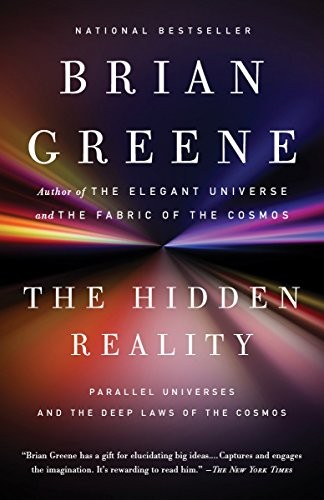
The Hidden Reality: Parallel Universes and the Deep Laws of the Cosmos by Brian Greene is a 2011 science book about multiverse, cosmology, quantum mechanics. The multiverse is not a single theory but a family of distinct proposals, each arising from a different area of physics, that independently suggest our universe may be one of many.
Summary
Brian Greene, a string theorist at Columbia University and the author of The Elegant Universe, devoted this book to a single sprawling question: does our universe have company? The Hidden Reality is a systematic survey of nine distinct multiverse proposals — theories arising from different corners of modern physics and mathematics that independently suggest our universe may be one of many. Greene's goal is not to advocate for any single theory but to show that the multiverse idea keeps appearing in physics whether physicists want it or not.
The nine varieties of multiverse Greene examines include the quilted multiverse (arising from infinite space and a finite set of possible particle configurations), the inflationary multiverse (from eternal cosmic inflation producing bubble universes), the brane multiverse (from string theory's higher-dimensional braneworld scenarios), the cyclic multiverse (from colliding membranes), the landscape multiverse (from string theory's enormous set of possible vacuum states), the quantum multiverse (from Everett's many-worlds interpretation), the holographic multiverse, the simulated multiverse, and the ultimate ensemble — the mathematical multiverse.
Greene is an unusually gifted explicator of difficult physics. He uses analogies, diagrams, and sustained metaphors to make ideas that live in abstract mathematics feel grounded. The Everett many-worlds sections are particularly strong: Greene explains clearly why some physicists find it the most economical interpretation of quantum mechanics, and why others find it extravagant. His coverage of the string landscape — the 10⁵⁰⁰ possible vacuum states of string theory that seem to make testable predictions nearly impossible — is honest about the challenges this creates for the theory.
The book is long and demanding. Greene writes clearly but the accumulated complexity of nine different cosmological frameworks is substantial. Readers looking for a summary of current physics will find more than they bargained for; readers genuinely curious about why serious physicists entertain the multiverse hypothesis will find the most thorough popular treatment available. The central tension — between the explanatory power of multiverse theories and their apparent untestability — runs through the whole book and is never fully resolved, because it hasn't been.
Talk to The Hidden Reality: Parallel Universes and the Deep Laws of the Cosmos like its author wrote you back.
Get the ideas that fit your life — not generic summaries.
- Chat with the book
- Audiobook-style main ideas
- Adapts to your life and goals
- Helps you take action
Key takeaways
- 1.
The multiverse is not a single theory but a family of distinct proposals, each arising from a different area of physics, that independently suggest our universe may be one of many.
- 2.
Eternal inflation predicts that quantum fluctuations in the early universe would create an infinite number of bubble universes, each potentially with different physical constants.
- 3.
String theory's landscape contains roughly 10⁵⁰⁰ possible vacuum states, each corresponding to a different universe with different physical constants. Some physicists see this as explaining why our universe seems fine-tuned.
- 4.
Everett's many-worlds interpretation of quantum mechanics proposes that every quantum measurement causes the universe to branch, with each possible outcome realized in a different branch.
- 5.
The holographic principle, derived from black hole physics, suggests that a region of space can be fully described by information on its boundary, one dimension lower.
- 6.
The fine-tuning problem — why the physical constants of our universe seem precisely calibrated for the existence of complex structures — is one motivation for multiverse theories.
- 7.
Most multiverse proposals are currently untestable. This raises genuine questions about whether they qualify as science, and Greene engages those questions rather than dismissing them.
- 8.
The simulated multiverse — the idea that our universe might be a computer simulation — is philosophically the most radical multiverse proposal and may be the hardest to distinguish from any other.
Discussion questions
Use these on your own, with a book club, or as chat starters in Superbook. Book club version, ready to copy or print →
- 1.
Greene surveys nine distinct multiverse proposals. Which one did you find most scientifically plausible, and why?
- 2.
The book distinguishes between theories that are currently untestable and theories that are in principle untestable. Does that distinction matter for whether something counts as science?
- 3.
Many-worlds proposes that every quantum measurement creates a branch where each outcome occurs. Is that a more or less disturbing idea than the Copenhagen interpretation's collapse of the wave function?
- 4.
The string landscape contains an enormous number of possible universes with different physical constants. Does that seem like an explanation of fine-tuning or an abandonment of the desire for a unique fundamental theory?
- 5.
Greene writes as a string theorist. Does his professional investment in string theory affect how you read his treatment of string-based multiverse proposals?
- 6.
The simulated multiverse is the most radical proposal in the book. What evidence, if any, could in principle distinguish a simulated universe from an 'real' one?
- 7.
Inflationary cosmology, which most cosmologists accept, predicts an eternally inflating multiverse as a consequence. Is accepting inflation without accepting the multiverse intellectually consistent?
- 8.
The book is longer and more demanding than most popular physics. Did the depth feel justified, or did some of the nine multiverse variants feel repetitive?
- 9.
Greene argues that untestable theories can still be scientifically valuable. Do you agree, and under what conditions?
- 10.
The fine-tuning problem motivates many multiverse theories. If the constants of nature were different, complex structures and life could not exist. Is that a physics problem or a philosophical one?
- 11.
Everett proposed many-worlds in the 1950s and was largely ignored. It gained more adherents decades later. What does that history suggest about how scientific acceptance works?
- 12.
After reading this book, do you think the multiverse is a scientific hypothesis, a philosophical speculation, or something in between?
Themes
Frequently asked questions
-
Is The Hidden Reality worth reading if I've already read The Elegant Universe?
Yes. The books cover different territory. The Elegant Universe focuses on string theory specifically; The Hidden Reality uses string theory as one thread in a broader survey of multiverse proposals from across physics. The overlap is modest and the new material is substantial.
-
How long does it take to read?
Around eight to nine hours. It is Greene's longest popular book. The chapters are largely independent, so readers interested in specific multiverse proposals can read selectively, but the cumulative argument benefits from reading in sequence.
-
What is the difference between the various multiverse proposals?
They arise from different physical theories and make different claims. The inflationary multiverse comes from cosmology; the many-worlds multiverse from quantum mechanics; the landscape multiverse from string theory; the holographic and simulated multiverses from information theory. Each implies a different kind of parallel existence.
-
Does Greene argue that the multiverse is real?
Not definitively. He argues that multiple independent areas of physics independently suggest something like the multiverse, that this convergence is significant, and that the question deserves serious attention. He acknowledges the testability problems and doesn't resolve them.
-
Who shouldn't read this book?
Readers who want a short, casual introduction to modern cosmology. The book is thorough and demands sustained attention. Readers looking for a lighter treatment should try Astrophysics for People in a Hurry or Seven Brief Lessons on Physics first.