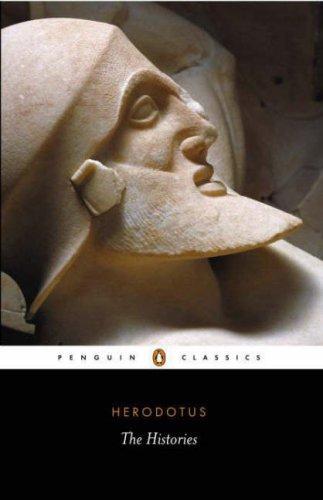
Talk to The Histories like its author wrote you back.
Get the ideas that fit your life — not generic summaries.
- Chat with the book
- Audiobook-style main ideas
- Adapts to your life and goals
- Helps you take action
What it argues
Herodotus wrote The Histories in the fifth century BCE as an inquiry into the causes of the wars between Greece and Persia that had recently convulsed the Mediterranean world. He coined the term "historia" — investigation — and built from it a work that ranges far beyond military narrative into ethnography, geography, mythology, and the customs of dozens of peoples from Egypt to Scythia. The result is both the founding document of Western historical writing and one of the strangest, most digressive books ever composed.
The main narrative traces the expansion of the Persian Empire from Croesus of Lydia through Cyrus, Cambyses, and Darius, culminating in Xerxes' invasion of Greece in 480 BCE. The battles of Marathon, Thermopylae, Salamis, and Plataea are covered in detail, with the Greek victories treated as a nearly miraculous check on Persian imperial ambition. But Herodotus is equally interested in the world the Persians moved through: he describes Egyptian mummies, Scythian horsemen, the customs of Babylonian women, and the strange democracies of Arabia with the same methodical curiosity he brings to battle tactics.
What it gets right
- 1.
Herodotus invented historical inquiry as a method: systematic investigation, weighing of sources, and acknowledgment of uncertainty rather than mythological explanation.
- 2.
The Persian Wars demonstrate that smaller, motivated defenders fighting on home terrain can defeat far larger imperial armies — a proposition still debated by military historians.
- 3.
Hubris is the central engine of historical tragedy. Every king who overreaches in Herodotus does so despite warnings, and the punishment is proportionate to the magnitude of the delusion.
What it covers
Who wrote it
Herodotus was born in Halicarnassus (modern Bodrum, Turkey) around 484 BCE and is known as the "father of history" — a title first given him by Cicero. He traveled extensively through Greece, Egypt, the Black Sea region, and the Near East, gathering oral traditions, interviewing witnesses, and examining physical evidence. He settled in Athens and later in the Athenian colony of Thurii in southern Italy, where he probably completed The Histories around 425 BCE. His work established the practice of inquiry-based historical writing and remained the primary source for knowledge of the Persian Wars until modern archaeology and epigraphy began to supplement and occasionally contradict it.
