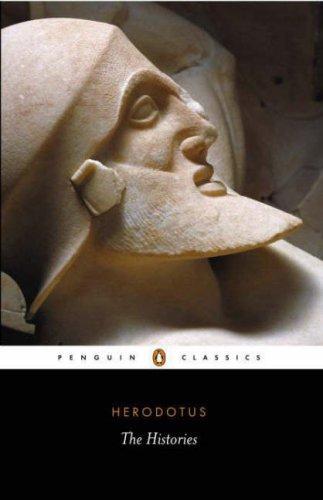
The Histories by Herodotus is a 1858 history book about war, empire, cultural diversity. Herodotus invented historical inquiry as a method: systematic investigation, weighing of sources, and acknowledgment of uncertainty rather than mythological explanation.
Summary
Herodotus wrote The Histories in the fifth century BCE as an inquiry into the causes of the wars between Greece and Persia that had recently convulsed the Mediterranean world. He coined the term "historia" — investigation — and built from it a work that ranges far beyond military narrative into ethnography, geography, mythology, and the customs of dozens of peoples from Egypt to Scythia. The result is both the founding document of Western historical writing and one of the strangest, most digressive books ever composed.
The main narrative traces the expansion of the Persian Empire from Croesus of Lydia through Cyrus, Cambyses, and Darius, culminating in Xerxes' invasion of Greece in 480 BCE. The battles of Marathon, Thermopylae, Salamis, and Plataea are covered in detail, with the Greek victories treated as a nearly miraculous check on Persian imperial ambition. But Herodotus is equally interested in the world the Persians moved through: he describes Egyptian mummies, Scythian horsemen, the customs of Babylonian women, and the strange democracies of Arabia with the same methodical curiosity he brings to battle tactics.
The recurring theme is hubris and its consequences. Croesus, Cyrus, Cambyses, Xerxes — each powerful ruler overreaches, ignores good advice, and suffers for it. Herodotus does not moralize mechanically, but the pattern is impossible to miss. The wise adviser who warns the king and is ignored appears in story after story. Divine retribution may not always be visible, but human overconfidence reliably produces its own punishment.
Herodotus was accused by Thucydides' admirers of credulity and by later scholars of unreliability, but modern archaeology and comparative evidence have vindicated him on many specific points his critics dismissed. He is honest about the limits of his knowledge — "I am obliged to report what is said, but I am not obliged to believe it" appears more than once. As a portrait of the ancient world in its full human variety, nothing else from antiquity comes close.
Talk to The Histories like its author wrote you back.
Get the ideas that fit your life — not generic summaries.
- Chat with the book
- Audiobook-style main ideas
- Adapts to your life and goals
- Helps you take action
Key takeaways
- 1.
Herodotus invented historical inquiry as a method: systematic investigation, weighing of sources, and acknowledgment of uncertainty rather than mythological explanation.
- 2.
The Persian Wars demonstrate that smaller, motivated defenders fighting on home terrain can defeat far larger imperial armies — a proposition still debated by military historians.
- 3.
Hubris is the central engine of historical tragedy. Every king who overreaches in Herodotus does so despite warnings, and the punishment is proportionate to the magnitude of the delusion.
- 4.
Cultural relativism runs through the work: Herodotus consistently presents foreign customs as equally valid expressions of human social organization, not evidence of barbarism.
- 5.
Thermopylae matters not because Sparta won but because the 300 demonstrated that total commitment to a cause changes the calculus of a larger enemy — a lesson in the military value of will.
- 6.
The Athenian decision to abandon their city and fight at sea at Salamis is treated as the decisive strategic choice of the wars — collective action under extreme pressure.
- 7.
Herodotus treats oracles and divine signs seriously but not uncritically. He notes when predictions prove accurate and when they are manipulated by interested parties.
- 8.
Geography shapes history: Herodotus constantly explains military outcomes, cultural practices, and political institutions by reference to the environments that produced them.
Discussion questions
Use these on your own, with a book club, or as chat starters in Superbook. Book club version, ready to copy or print →
- 1.
Herodotus says he is 'obliged to report what is said but not obliged to believe it.' Does this methodological honesty make him a better or worse historical source than writers who simply assert facts?
- 2.
The theme of hubris — powerful men ignoring wise advice and suffering for it — runs through the whole work. Is this a genuine historical pattern Herodotus observed, or a moral framework he imposed on events?
- 3.
Herodotus is far more interested in the cultures he describes than Thucydides. Does that broader curiosity make The Histories more or less useful as history?
- 4.
The Thermopylae story has been appropriated by many political movements since antiquity. What does Herodotus himself seem to think the Spartans were defending, and does that match modern uses of the story?
- 5.
Herodotus describes women, slaves, and non-Greeks with more attention than most ancient writers. Does his ethnographic curiosity translate into anything like moral equality?
- 6.
The Persian Wars are presented as a contest between freedom and slavery, yet Athens itself relied on enslaved labor and controlled an empire. Does Herodotus acknowledge this tension?
- 7.
Croesus is warned that his happiness will not last, loses everything, and eventually becomes an adviser to Cyrus. What does his arc suggest about Herodotus' view of knowledge and fate?
- 8.
Which battle in the Persian Wars do you think Herodotus considers the most important? Does his own emphasis match the historical consensus?
- 9.
Herodotus describes dozens of foreign peoples with what looks like genuine curiosity. How does reading ancient ethnography change how you think about cultural description in your own time?
- 10.
The oracle at Delphi appears throughout the work, usually giving advice that proves correct when correctly interpreted. What role does religion play in Herodotus' historical explanations?
- 11.
Modern readers often prefer Thucydides for his analytical rigor. What would we lose if we read only Thucydides and not Herodotus?
- 12.
Herodotus ends his work without a formal conclusion. What does the open ending suggest about his view of history as an ongoing process rather than a resolved narrative?
Themes
Frequently asked questions
-
Is The Histories by Herodotus worth reading today?
Yes, particularly for readers interested in the ancient world, the origins of historical writing, or comparative culture. It is more entertaining than most ancient texts — full of strange stories, colorful personalities, and ethnographic digressions — but requires patience with a non-linear structure.
-
What translation of Herodotus should I read?
The Penguin Classics translation by Aubrey de Sélincourt (revised by John Marincola) is approachable and reliable. The Landmark Herodotus, edited by Robert Strassler, adds maps, notes, and appendices that help with geography and context and is worth the investment for serious readers.
-
How long does it take to read The Histories?
Around thirteen hours at average reading pace for the full nine books, though Herodotus' digressions reward slow reading. Most readers move unevenly through it — quickly through the battles, slowly through the ethnographic sections.
-
What is the main message of The Histories?
That human greatness is temporary, that overconfidence invites catastrophe, and that the full complexity of human cultures deserves honest inquiry. Herodotus does not reduce history to a single lesson, but the pattern of hubris and reversal is consistent enough to read as a sustained argument about power.
-
How reliable is Herodotus as a historical source?
More reliable than his ancient critics admitted. Modern archaeology has confirmed many of his descriptions that were once dismissed as invention. He is least reliable on numbers — particularly casualty counts — and most reliable on cultural practices and geographical descriptions. He is transparent about his sources in ways that allow readers to assess his credibility.