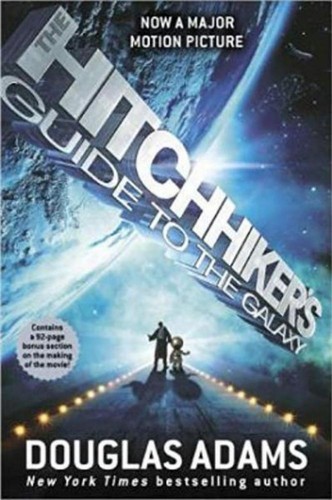
Talk to The Hitchhiker's Guide to the Galaxy like its author wrote you back.
Get the ideas that fit your life — not generic summaries.
- Chat with the book
- Audiobook-style main ideas
- Adapts to your life and goals
- Helps you take action
What it argues
The Hitchhiker's Guide to the Galaxy begins with Earth being demolished to make way for a hyperspace bypass. The requisite planning notices had been on display in a local planning office for fifty years. This is how Douglas Adams announces his project: the universe operates on bureaucratic logic, meaning is a category error, and the appropriate response to all of this is a cup of tea and a comfortable sofa, if available.
Arthur Dent, an entirely ordinary Englishman, is rescued from the demolition by his friend Ford Prefect, who turns out to be a researcher for an enormous interstellar guidebook rather than someone from Guildford. They hitch a ride on a Vogon constructor fleet and begin a series of encounters with the galaxy's peculiarities: a two-headed president who has stolen the most improbable spaceship ever built, a chronically depressed robot, a restaurant at the end of the universe, and the revelation that the Earth was itself a giant organic computer designed to find the question whose answer is 42.
What it gets right
- 1.
The answer to life, the universe, and everything is 42 — and the point is that the question doesn't exist, which means the answer is useless. Adams is arguing that meaning can't be computed because meaning requires the right question, and we don't have it.
- 2.
Marvin the Paranoid Android is the most honest character in the book: he has a brain the size of a planet, no purpose commensurate with that brain, and a perfectly reasonable response to the situation.
- 3.
The Vogons — cruel by indifference rather than malice, enforcing rules that exist because rules exist — are Adams's portrait of bureaucratic evil, which he considered more dangerous than the dramatic kind.
What it covers
Who wrote it
Douglas Adams was a British author, screenwriter, and humorist best known for The Hitchhiker's Guide to the Galaxy, which began as a BBC radio comedy in 1978 and was adapted into a novel, a TV series, a stage play, a computer game, a towel, and eventually a film. The five-book "trilogy" — including The Restaurant at the End of the Universe, Life, the Universe and Everything, So Long, and Thanks for All the Fish, and Mostly Harmless — has sold more than fifteen million copies worldwide. Adams was also a committed environmentalist and co-wrote Last Chance to See (1990) about endangered species. He died of a heart attack in 2001 at age 49.
