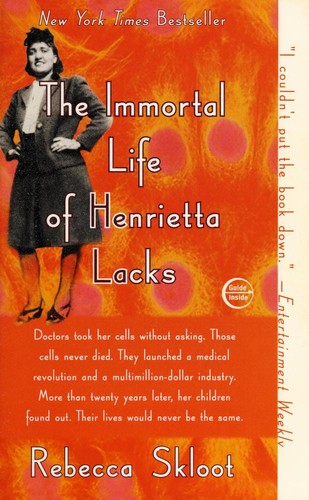
Talk to The Immortal Life of Henrietta Lacks like its author wrote you back.
Get the ideas that fit your life — not generic summaries.
- Chat with the book
- Audiobook-style main ideas
- Adapts to your life and goals
- Helps you take action
The Immortal Life of Henrietta Lacks, in detail
In 1951, a Black woman named Henrietta Lacks died of cervical cancer at Johns Hopkins Hospital. Before she died, a surgeon removed cells from her tumor without her knowledge or consent. Those cells — called HeLa — turned out to be the first human cells that could survive and multiply indefinitely in a lab. They became one of the most important tools in medical history, used in developing the polio vaccine, cancer research, gene mapping, and countless pharmaceutical studies. Henrietta Lacks herself was buried in an unmarked grave. Her family learned about HeLa decades later, largely by accident.
Rebecca Skloot spent nearly a decade reporting this story, weaving together three threads: the science of what HeLa cells made possible, the history of how they were taken and commercialized, and the lives of the Lacks family — particularly Henrietta's daughter Deborah, who became Skloot's guide and the book's emotional center. The result is less a biography than an investigation. Skloot traces how the medical establishment treated Black patients in the Jim Crow South, how informed consent evolved (slowly and incompletely) as a legal and ethical standard, and how the HeLa cell line became a billion-dollar industry whose profits never reached the family whose body it came from.
The book is strongest on the collision between science and personhood. Henrietta Lacks was not a willing donor, a patient who understood what was being taken, or a name that appeared on the papers citing her cells. She was a person reduced to a biological resource. Skloot is careful not to reduce the scientists involved to villains — the norms of the time were what they were — but she does not let those norms off the hook either. The ethical questions the book raises about tissue ownership, consent, and the commercialization of human biology remain unresolved and have grown more pressing with genetic data now routinely collected by hospitals and consumer testing companies.
Skloot writes with the pacing of narrative journalism and the rigor of a science journalist. Some readers find the back-and-forth structure between past and present slows the momentum, and the science sections occasionally outpace the storytelling. But the Deborah chapters carry the book. By the time Skloot and Deborah visit the lab where HeLa cells are still growing, the scene lands with genuine weight. The book does what the best science writing does: it makes an abstract question — who owns the cells in your body? — land as a human story with a specific family, a specific injustice, and no clean ending.
The big ideas
- 1.
Henrietta Lacks's cells, taken without consent in 1951, became the most widely used human cell line in history and underpinned research worth billions of dollars — none of which reached her family.
- 2.
The HeLa cell line contributed to the polio vaccine, cancer research, and gene mapping. The scale of its scientific impact is not disputed; the ethics of how it was obtained very much are.
- 3.
Informed consent in American medicine was not a meaningful standard in 1951, particularly for Black patients in segregated hospitals. The Lacks case is a case study in how medical progress was built on that absence.
