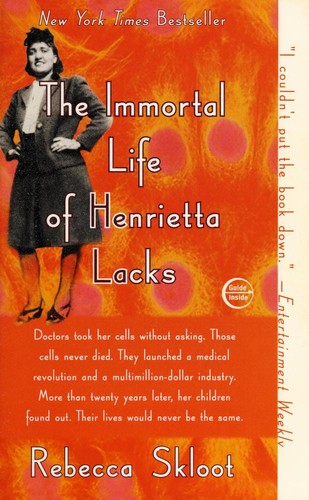
The Immortal Life of Henrietta Lacks by Rebecca Skloot is a 2010 science book about medical ethics, race and medicine, scientific exploitation. Henrietta Lacks's cells, taken without consent in 1951, became the most widely used human cell line in history and underpinned research worth billions of dollars — none of which reached her family.
Summary
In 1951, a Black woman named Henrietta Lacks died of cervical cancer at Johns Hopkins Hospital. Before she died, a surgeon removed cells from her tumor without her knowledge or consent. Those cells — called HeLa — turned out to be the first human cells that could survive and multiply indefinitely in a lab. They became one of the most important tools in medical history, used in developing the polio vaccine, cancer research, gene mapping, and countless pharmaceutical studies. Henrietta Lacks herself was buried in an unmarked grave. Her family learned about HeLa decades later, largely by accident.
Rebecca Skloot spent nearly a decade reporting this story, weaving together three threads: the science of what HeLa cells made possible, the history of how they were taken and commercialized, and the lives of the Lacks family — particularly Henrietta's daughter Deborah, who became Skloot's guide and the book's emotional center. The result is less a biography than an investigation. Skloot traces how the medical establishment treated Black patients in the Jim Crow South, how informed consent evolved (slowly and incompletely) as a legal and ethical standard, and how the HeLa cell line became a billion-dollar industry whose profits never reached the family whose body it came from.
The book is strongest on the collision between science and personhood. Henrietta Lacks was not a willing donor, a patient who understood what was being taken, or a name that appeared on the papers citing her cells. She was a person reduced to a biological resource. Skloot is careful not to reduce the scientists involved to villains — the norms of the time were what they were — but she does not let those norms off the hook either. The ethical questions the book raises about tissue ownership, consent, and the commercialization of human biology remain unresolved and have grown more pressing with genetic data now routinely collected by hospitals and consumer testing companies.
Skloot writes with the pacing of narrative journalism and the rigor of a science journalist. Some readers find the back-and-forth structure between past and present slows the momentum, and the science sections occasionally outpace the storytelling. But the Deborah chapters carry the book. By the time Skloot and Deborah visit the lab where HeLa cells are still growing, the scene lands with genuine weight. The book does what the best science writing does: it makes an abstract question — who owns the cells in your body? — land as a human story with a specific family, a specific injustice, and no clean ending.
Talk to The Immortal Life of Henrietta Lacks like its author wrote you back.
Get the ideas that fit your life — not generic summaries.
- Chat with the book
- Audiobook-style main ideas
- Adapts to your life and goals
- Helps you take action
Key takeaways
- 1.
Henrietta Lacks's cells, taken without consent in 1951, became the most widely used human cell line in history and underpinned research worth billions of dollars — none of which reached her family.
- 2.
The HeLa cell line contributed to the polio vaccine, cancer research, and gene mapping. The scale of its scientific impact is not disputed; the ethics of how it was obtained very much are.
- 3.
Informed consent in American medicine was not a meaningful standard in 1951, particularly for Black patients in segregated hospitals. The Lacks case is a case study in how medical progress was built on that absence.
- 4.
Tissue removed from a patient during treatment has historically belonged to the hospital, not the patient. Courts have repeatedly declined to give patients property rights over their own cells once they leave the body.
- 5.
Deborah Lacks spent much of her adult life trying to understand what happened to her mother and what HeLa cells were. Her search for knowledge — hampered by limited education and institutional indifference — is the book's emotional spine.
- 6.
The commercialization of HeLa cells — sold by cell-supply companies, licensed for pharmaceutical use — happened entirely outside the Lacks family's awareness or benefit for decades.
- 7.
Race shaped every aspect of the HeLa story: where Henrietta was treated, how her cells were used, how her family was treated when they sought answers, and who profited.
- 8.
Questions about who owns human biological material — cells, genes, data — remain legally and ethically unresolved. The Lacks case established no clear precedent and the issues have only expanded with genetic medicine.
Discussion questions
Use these on your own, with a book club, or as chat starters in Superbook. Book club version, ready to copy or print →
- 1.
Henrietta's cells were taken under a standard practice of the time, not out of malice. Does intent change how you judge what happened to her and her family?
- 2.
The Lacks family received no compensation while HeLa cells generated enormous commercial value. What would a fair resolution look like — and is it still possible decades later?
- 3.
Skloot spent years building trust with Deborah Lacks to write this book. What are the ethics of a journalist inserting herself so deeply into a family's grief and story?
- 4.
The book raises the question of who owns tissue removed from your body during a medical procedure. What do you think the answer should be, and why?
- 5.
Deborah's desire to know her mother was complicated by what she found. How did learning about HeLa change — or not change — her understanding of who Henrietta was as a person?
- 6.
Informed consent has evolved significantly since 1951, but the book suggests it is still imperfect. What limitations do you see in how consent works in medicine or research today?
- 7.
Hopkins and the researchers who used HeLa were following the norms of their era. At what point does following accepted norms stop being a defense?
- 8.
Skloot depicts the Lacks family dealing with institutions — hospitals, researchers, journalists — that repeatedly failed to treat them as full participants in their own story. What would those encounters have looked like if handled well?
- 9.
The same cells that helped eradicate polio came from a woman who was not given the chance to volunteer them. How do you hold both of those things at once?
- 10.
Race appears throughout the book as a structural force rather than individual prejudice. Where in the story did you feel it most sharply, and why?
- 11.
Consumer genetic testing companies now collect and sometimes sell genetic data from millions of customers. How does the HeLa story change how you think about what you agree to when you submit a DNA sample?
- 12.
Deborah never had access to the education or resources to fully understand what had been done or to advocate for herself. How does that shape what justice would mean in her case?
Themes
Frequently asked questions
-
What is The Immortal Life of Henrietta Lacks about?
It tells the story of Henrietta Lacks, a Black woman whose cancer cells were taken without consent in 1951 and became the HeLa cell line — one of the most important tools in modern medicine. The book weaves together the history of HeLa, the ethics of tissue ownership and medical consent, and the story of the Lacks family, particularly Henrietta's daughter Deborah.
-
Is The Immortal Life of Henrietta Lacks worth reading?
Yes, especially if you're interested in medical ethics, race and medicine, or science narrative. It asks hard questions about consent and exploitation that haven't been resolved and have become more relevant with the rise of genetic medicine. The Deborah chapters are particularly strong. Some readers find the structural interweaving of timelines slow, but the payoff is earned.
-
How long does it take to read The Immortal Life of Henrietta Lacks?
Around seven to eight hours at average reading pace for the roughly 370-page book. The narrative journalism style keeps it accessible, though the science sections require some attention. It works well read across several sessions.
-
Who should read The Immortal Life of Henrietta Lacks?
Anyone interested in bioethics, the history of American medicine, or race and institutional power. It's also a compelling choice for readers who want rigorous nonfiction that reads like a story. Medical professionals and students often find the consent history especially useful for thinking about present-day practices.
-
What's the most important question the book raises?
Who owns the tissue taken from your body during a medical procedure? Courts have largely said: not you, once it leaves your body. The HeLa case made that question visible, but it established no clear precedent. Skloot shows how much turns on that unanswered question — and how the answer has consistently favored institutions over individuals.
Similar books

The Emperor of All Maladies: A Biography of Cancer
Siddhartha Mukherjee

When Breath Becomes Air
Paul Kalanithi
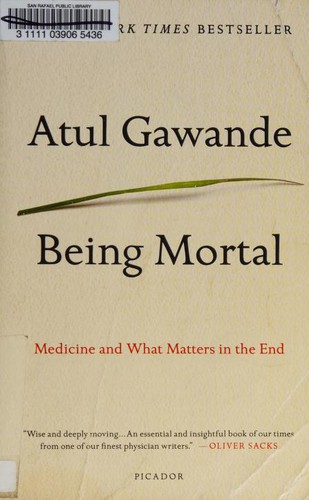
Being Mortal: Medicine and What Matters in the End
Atul Gawande
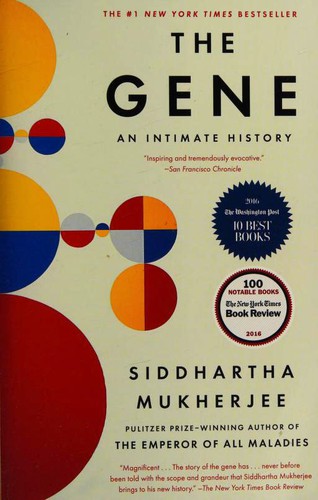
The Gene: An Intimate History
Siddhartha Mukherjee
