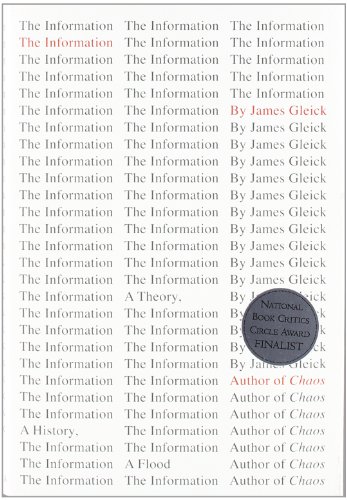
Talk to The Information: A History, a Theory, a Flood like its author wrote you back.
Get the ideas that fit your life — not generic summaries.
- Chat with the book
- Audiobook-style main ideas
- Adapts to your life and goals
- Helps you take action
What it argues
The Information traces the history of information — as a concept, a technology, and a way of understanding the universe — from the talking drums of West Africa through the telegraph, the printing press, the telephone, and into the digital age. James Gleick's argument is that information is not just a byproduct of human communication but one of the most fundamental concepts in science, and that the twentieth century's greatest intellectual achievement was learning to think precisely about it.
The book's central figure is Claude Shannon, the Bell Labs mathematician who in 1948 published "A Mathematical Theory of Communication," one of the most consequential papers of the twentieth century. Shannon defined information in terms of surprise and uncertainty: a message carries information in proportion to how much it reduces uncertainty. He introduced the bit as the unit of information, defined the channel capacity of communication systems, and proved the existence of error-correcting codes that allow reliable communication across noisy channels. These ideas underpinned the entire digital age — from hard drives to the internet — but Shannon remained obscure outside engineering until writers like Gleick began explaining his work to general audiences.
What it gets right
- 1.
Claude Shannon's 1948 paper defined information mathematically — as the reduction of uncertainty — and introduced the bit as its unit, laying the foundation for the entire digital age.
- 2.
Shannon proved that any communication channel has a maximum information capacity — the channel capacity — and that reliable transmission at rates below this limit is always possible regardless of noise.
- 3.
The mathematics of entropy in thermodynamics and of entropy in information theory are the same. Shannon's entropy and Boltzmann's entropy describe different phenomena with identical formulas.
What it covers
Who wrote it
James Gleick is an American author and journalist who has written about science and technology for over four decades. His books include Chaos: Making a New Science, Genius: The Life and Science of Richard Feynman, and Time Travel: A History. Gleick co-founded one of the early internet service providers in the 1990s and has written for The New York Times. The Information received the Royal Society Winton Prize for Science Books in 2012 and is widely regarded as the best popular history of information theory available.
