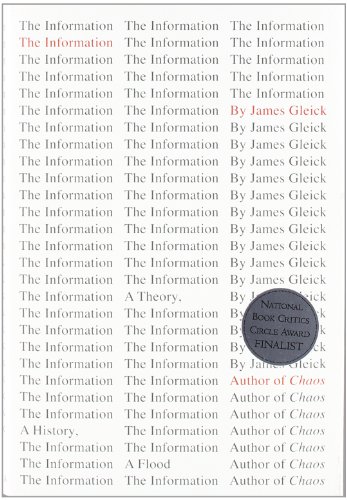
The Information: A History, a Theory, a Flood by James Gleick is a 2011 science book about information theory, communication, entropy. Claude Shannon's 1948 paper defined information mathematically — as the reduction of uncertainty — and introduced the bit as its unit, laying the foundation for the entire digital age.
Summary
The Information traces the history of information — as a concept, a technology, and a way of understanding the universe — from the talking drums of West Africa through the telegraph, the printing press, the telephone, and into the digital age. James Gleick's argument is that information is not just a byproduct of human communication but one of the most fundamental concepts in science, and that the twentieth century's greatest intellectual achievement was learning to think precisely about it.
The book's central figure is Claude Shannon, the Bell Labs mathematician who in 1948 published "A Mathematical Theory of Communication," one of the most consequential papers of the twentieth century. Shannon defined information in terms of surprise and uncertainty: a message carries information in proportion to how much it reduces uncertainty. He introduced the bit as the unit of information, defined the channel capacity of communication systems, and proved the existence of error-correcting codes that allow reliable communication across noisy channels. These ideas underpinned the entire digital age — from hard drives to the internet — but Shannon remained obscure outside engineering until writers like Gleick began explaining his work to general audiences.
Gleick pursues information through unexpected historical channels: the development of the Oxford English Dictionary as a technology for capturing the instability of language; Charles Babbage's mechanical calculating engines; Ada Lovelace's early conceptualization of programming; the genetics code as a form of information storage; and the thermodynamic interpretation of entropy as a measure of disorder that Shannon and the physicist Leo Szilard recognized was equivalent to information. The connections between thermodynamic entropy and Shannon entropy — the same mathematics describing two apparently unrelated things — are among the book's most striking passages.
The final chapters address the information overload of the contemporary world: the way an abundance of information creates new forms of scarcity (of attention, of curation, of judgment), and the question of whether the universe itself is, at some fundamental level, informational. These speculative sections are less resolved than the historical narrative, but they give the book an ambition proportionate to its subject.
Talk to The Information: A History, a Theory, a Flood like its author wrote you back.
Get the ideas that fit your life — not generic summaries.
- Chat with the book
- Audiobook-style main ideas
- Adapts to your life and goals
- Helps you take action
Key takeaways
- 1.
Claude Shannon's 1948 paper defined information mathematically — as the reduction of uncertainty — and introduced the bit as its unit, laying the foundation for the entire digital age.
- 2.
Shannon proved that any communication channel has a maximum information capacity — the channel capacity — and that reliable transmission at rates below this limit is always possible regardless of noise.
- 3.
The mathematics of entropy in thermodynamics and of entropy in information theory are the same. Shannon's entropy and Boltzmann's entropy describe different phenomena with identical formulas.
- 4.
Information is physical: storing and transmitting bits has real energy costs, a connection that links information theory to the fundamental laws of physics through Maxwell's demon and Landauer's principle.
- 5.
Genes encode biological information in a four-letter chemical alphabet; the conceptual apparatus Shannon developed to analyze communication applies directly to molecular biology.
- 6.
The printing press was an information technology that transformed European society not just by spreading knowledge but by enabling cumulative error correction through widespread comparison of copies.
- 7.
Talking drums in West Africa encoded speech using tonal patterns that carried information across long distances — a communication technology that predated written language by centuries.
- 8.
Information abundance creates attention scarcity: as the cost of producing and distributing information falls toward zero, the bottleneck shifts to human capacity to evaluate and trust what we receive.
Discussion questions
Use these on your own, with a book club, or as chat starters in Superbook. Book club version, ready to copy or print →
- 1.
Shannon defined information as the reduction of uncertainty rather than as meaning. Does that definition feel right to you, or does it leave out something important?
- 2.
The same mathematics describes thermodynamic entropy and information entropy. What does it mean when two apparently unrelated phenomena obey identical mathematical laws?
- 3.
Gleick traces a long history of information technologies — drums, writing, printing, telegraph, digital. What pattern do you notice in how each new technology changed society?
- 4.
Shannon's work was purely theoretical; it described what was possible without specifying how to achieve it. How important is that kind of theoretical work relative to applied engineering?
- 5.
The book argues that genes are information. Does that metaphor illuminate biology or import a framework that distorts it?
- 6.
Gleick suggests we are drowning in information but starving for knowledge. Does that describe your own experience, and how do you manage it?
- 7.
Ada Lovelace conceptualized programming before any computer existed to program. What does that example tell you about the relationship between ideas and the technology they require?
- 8.
Shannon deliberately separated the meaning of information from its mathematical treatment. Is meaning ultimately irrelevant to how information systems work, or does he leave something important out?
- 9.
Gleick connects information theory to quantum mechanics and the nature of physical reality. Does the idea that the universe is 'made of information' mean anything to you?
- 10.
The telegraph changed the nature of news by making it possible to transmit information faster than physical transport. What current information technology is changing the nature of knowledge in a comparably fundamental way?
- 11.
How does your own information diet — what you read, filter, and trust — compare to Gleick's description of the challenge of navigating information abundance?
- 12.
The book covers a vast historical sweep. Which chapter or period did you find most surprising or illuminating?
Themes
Frequently asked questions
-
What is information theory?
Information theory is the mathematical study of how information can be quantified, stored, and transmitted. Claude Shannon founded the field in 1948 with a paper that introduced the bit as the unit of information and proved fundamental limits on how much information any channel can carry. It underlies all of digital computing and communications.
-
Do I need a technical background to read The Information?
No. Gleick is a journalist and writer first; the technical ideas are explained through history and analogy. Readers with backgrounds in mathematics or computer science will recognize some familiar concepts, but the book is written for general readers and rewards them.
-
What is the connection between Shannon entropy and thermodynamic entropy?
Both are measures of disorder or uncertainty, and they obey the same mathematical formula. Shannon entropy measures the uncertainty in an information source; thermodynamic entropy measures the disorder of a physical system. The physicist John von Neumann suggested Shannon use 'entropy' precisely because of this connection.
-
Who is Claude Shannon and why is he important?
Shannon was a mathematician at Bell Labs who published the foundational paper of information theory in 1948. His work defined what information is, how to measure it, and what limits apply to communication. Every digital device and network in use today is built on ideas that trace back to that paper.
-
Is this book about the internet?
The internet is one end point of a much longer story. The book begins with ancient information technologies — talking drums, written language — and traces how human capacity to store and transmit information has grown and what consequences that growth has had. The digital age is the current chapter, not the whole story.
Similar books
Chaos: Making a New Science
James Gleick
Genius: The Life and Science of Richard Feynman
James Gleick
Code: The Hidden Language of Computer Hardware and Software
Charles Petzold
The Master Algorithm
Pedro Domingos
