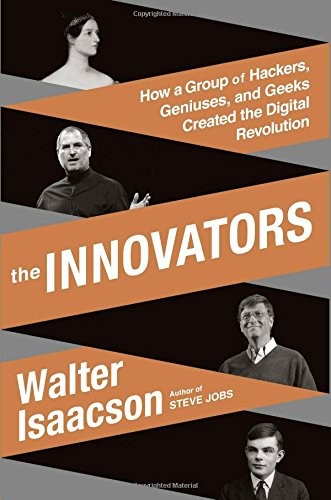
Talk to The Innovators: How a Group of Hackers, Geniuses, and Geeks Created the Digital Revolution like its author wrote you back.
Get the ideas that fit your life — not generic summaries.
- Chat with the book
- Audiobook-style main ideas
- Adapts to your life and goals
- Helps you take action
What it argues
The Innovators is Walter Isaacson's history of the digital revolution, tracing the development of computers and the internet from Ada Lovelace's conceptualization of programming in the 1840s through the emergence of the modern internet, personal computer, and smartphone. Isaacson, who wrote biographies of Einstein, Jobs, and da Vinci, applies the same biographical-narrative approach here, but the subject is not a single genius — it is the collaborative process by which generations of engineers, mathematicians, entrepreneurs, and hobbyists produced a transformation in human capability.
The book's organizing thesis is that the digital revolution was a product of collaboration, not lone geniuses. Isaacson directly challenges the heroic inventor narrative: while individual talent mattered enormously, every major innovation — the transistor, the computer, the internet, the microprocessor, the personal computer, the World Wide Web — emerged from teams, from the intersection of different disciplines, and from communities that built on each other's work. He repeatedly shows that when multiple people are working on the same idea simultaneously, it is usually because conditions are ripe rather than because one visionary saw what others missed.
What it gets right
- 1.
The digital revolution was produced by collaboration: every major innovation, from the transistor to the internet, emerged from teams rather than lone inventors, often in multiple locations simultaneously.
- 2.
Ada Lovelace conceptualized programming — writing instructions that a machine could execute to perform general computations — nearly a century before a machine capable of running those programs existed.
- 3.
The transistor, invented at Bell Labs in 1947, replaced vacuum tubes and made modern computing possible. The invention required the collaboration of theoretical physicist William Shockley, experimentalist Walter Brattain, and theorist John Bardeen.
What it covers
Who wrote it
Walter Isaacson is an American author and journalist who has served as CEO of the Aspen Institute, chair of CNN, and editor of Time magazine. His biographies include Leonardo da Vinci, Benjamin Franklin, Albert Einstein, Steve Jobs, and Jennifer Doudna. The Innovators was his first book on a collective subject rather than a single individual. He is currently a professor of history at Tulane University. His books are known for their narrative accessibility and breadth of research, and occasionally criticized for prioritizing biography over structural or technical analysis.
