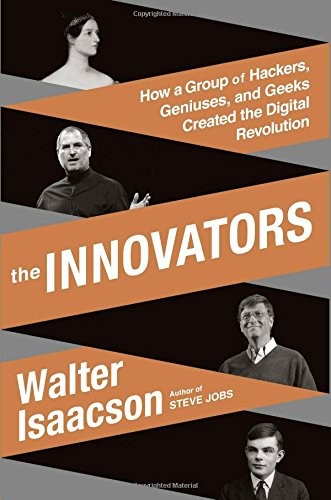
The Innovators: How a Group of Hackers, Geniuses, and Geeks Created the Digital Revolution by Walter Isaacson is a 2014 science book about technology history, collaboration, computing. The digital revolution was produced by collaboration: every major innovation, from the transistor to the internet, emerged from teams rather than lone inventors, often in multiple locations simultaneously.
Summary
The Innovators is Walter Isaacson's history of the digital revolution, tracing the development of computers and the internet from Ada Lovelace's conceptualization of programming in the 1840s through the emergence of the modern internet, personal computer, and smartphone. Isaacson, who wrote biographies of Einstein, Jobs, and da Vinci, applies the same biographical-narrative approach here, but the subject is not a single genius — it is the collaborative process by which generations of engineers, mathematicians, entrepreneurs, and hobbyists produced a transformation in human capability.
The book's organizing thesis is that the digital revolution was a product of collaboration, not lone geniuses. Isaacson directly challenges the heroic inventor narrative: while individual talent mattered enormously, every major innovation — the transistor, the computer, the internet, the microprocessor, the personal computer, the World Wide Web — emerged from teams, from the intersection of different disciplines, and from communities that built on each other's work. He repeatedly shows that when multiple people are working on the same idea simultaneously, it is usually because conditions are ripe rather than because one visionary saw what others missed.
The historical chapters trace the key developments in sequence: Babbage's mechanical computing engine and Lovelace's notes that envisioned programming; the early electrical computers of the 1940s built at multiple sites simultaneously; the transistor invented at Bell Labs by a team including Shockley, Bardeen, and Brattain; the integrated circuit developed independently by Kilby and Noyce; the ARPANET precursor to the internet; the personal computer culture of the 1970s Bay Area; the GUI and mouse from Xerox PARC; and the web browser and web server from Tim Berners-Lee at CERN.
Isaacson is a skilled narrative writer but not a technologist, and the technical depth is uneven. Readers who want the social and historical narrative will find it excellent; readers who want deeper technical understanding of how the technologies work will need to supplement it.
Talk to The Innovators: How a Group of Hackers, Geniuses, and Geeks Created the Digital Revolution like its author wrote you back.
Get the ideas that fit your life — not generic summaries.
- Chat with the book
- Audiobook-style main ideas
- Adapts to your life and goals
- Helps you take action
Key takeaways
- 1.
The digital revolution was produced by collaboration: every major innovation, from the transistor to the internet, emerged from teams rather than lone inventors, often in multiple locations simultaneously.
- 2.
Ada Lovelace conceptualized programming — writing instructions that a machine could execute to perform general computations — nearly a century before a machine capable of running those programs existed.
- 3.
The transistor, invented at Bell Labs in 1947, replaced vacuum tubes and made modern computing possible. The invention required the collaboration of theoretical physicist William Shockley, experimentalist Walter Brattain, and theorist John Bardeen.
- 4.
ARPANET, the precursor to the internet, was designed with distributed architecture rather than central switching partly because of military concern about nuclear resilience. That architectural decision shapes the internet's structure to this day.
- 5.
The microprocessor — putting an entire CPU on a single chip — democratized computing by making it cheap enough for hobbyists and small businesses, setting the stage for the personal computer era.
- 6.
Xerox PARC developed the graphical user interface, the mouse, object-oriented programming, and Ethernet in the 1970s but failed to commercialize them. Apple and later Microsoft built on this research.
- 7.
Tim Berners-Lee created the World Wide Web at CERN in 1989–91 and deliberately made it open and free rather than proprietary — a decision that shaped the web's explosive growth.
- 8.
The cultures and incentive structures of creative communities matter as much as individual brilliance: Bell Labs, PARC, MIT's Tech Model Railroad Club, and the Homebrew Computer Club each produced innovations that their respective cultures made possible.
Discussion questions
Use these on your own, with a book club, or as chat starters in Superbook. Book club version, ready to copy or print →
- 1.
Isaacson argues collaboration rather than lone genius drove the digital revolution. Does that argument change how you think about innovation in other fields?
- 2.
Ada Lovelace conceptualized programming before programmable computers existed. What does that example tell you about the relationship between ideas and the technology they require?
- 3.
Bell Labs produced the transistor, information theory, and numerous other foundational innovations. What made that environment so fertile, and can it be reproduced?
- 4.
ARPANET was designed to survive nuclear attack through distributed routing. How does an infrastructure decision made for one reason shape how a technology develops for entirely different reasons?
- 5.
Xerox PARC invented the GUI but failed to commercialize it. What does that story tell you about the difference between invention and innovation?
- 6.
The book traces ideas from Lovelace through the smartphone. Are there threads that Isaacson's emphasis on collaboration makes harder to see?
- 7.
Several women — Lovelace, Grace Hopper, the ENIAC programmers — made foundational contributions that were obscured for decades. What does that pattern say about how innovation communities operate?
- 8.
What is the most important factor that led different groups — often working in parallel — to arrive at similar innovations at roughly the same time?
- 9.
The internet was built largely with public funding before being released for commercial use. What does that pattern suggest about the relationship between public and private investment in innovation?
- 10.
Tim Berners-Lee chose not to patent the World Wide Web. Was that the right decision?
- 11.
What innovation from this history do you think is most underappreciated, and why?
- 12.
Isaacson makes heroes of the people he writes about. Does the admiration ever make the narrative feel uncritical?
Themes
Frequently asked questions
-
Is The Innovators technically deep?
Moderately. Isaacson explains each technology clearly enough to understand what it did and why it mattered. He is less strong on how these technologies work at a deeper level. Readers who want more technical depth on any topic will need specialized histories.
-
What is the book's main argument?
That the digital revolution was produced by collaborative, community-based innovation rather than lone geniuses. Isaacson makes this argument consistently across all the technologies he covers, from the transistor through the internet.
-
Does it cover the modern internet and smartphones?
It ends with the emergence of the internet, personal computing, and the web, but it was published in 2014 and does not cover the smartphone era, social media, or cloud computing in depth.
-
Who are the most interesting people in the book?
Ada Lovelace, who conceptualized programming in the 1840s, and Grace Hopper, who developed early compilers and helped standardize computer languages, are often cited by readers as the most striking figures. J.C.R. Licklider's vision of interactive computing also stands out.
-
Is it better or worse than Isaacson's biography of Steve Jobs?
Different in structure and intention. The Jobs biography is more intimate and more critical of its subject. The Innovators is broader in scope and makes a sustained argument about collaboration. Both are well-written narrative histories at similar length.
Similar books
The Information: A History, a Theory, a Flood
James Gleick
Code: The Hidden Language of Computer Hardware and Software
Charles Petzold
Hackers: Heroes of the Computer Revolution
Steven Levy
Blue Ocean Strategy
W. Chan Kim and Renée Mauborgne
