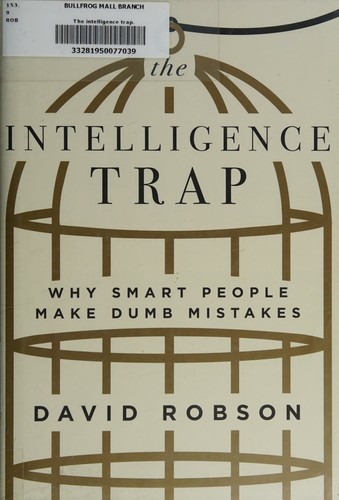
Talk to The Intelligence Trap: Why Smart People Make Dumb Mistakes like its author wrote you back.
Get the ideas that fit your life — not generic summaries.
- Chat with the book
- Audiobook-style main ideas
- Adapts to your life and goals
- Helps you take action
What it argues
The Intelligence Trap is science journalist David Robson's investigation into a paradox: high intelligence and education do not protect against bad reasoning, and can actively make it worse. Robson draws on cognitive psychology, behavioral economics, and biographical research to document how intelligent people — doctors, scientists, politicians, even Nobel laureates — make systematic errors that their intelligence should theoretically prevent. The result is a book about the limits of IQ as a predictor of sound judgment and the distinct skills that actually produce good thinking.
The core claim is that intelligence, as measured by IQ or academic credential, tells you a great deal about a person's cognitive capacity but almost nothing about how they apply it. Robson introduces the concept of "dysrationalia" — rationality failures in intelligent people — and argues that high-IQ individuals often have more elaborate and coherent justifications for their biases than less intelligent people. They are better at constructing post-hoc rationalizations, better at finding evidence that confirms their existing views, and more confident that their reasoning is sound when it isn't. The book cites studies showing that measures of analytical thinking and actively open-minded thinking predict good judgment far better than IQ.
What it gets right
- 1.
High IQ predicts academic performance and certain cognitive tasks but does not predict sound judgment, rational decision-making, or resistance to motivated reasoning.
- 2.
Intelligent people are often more vulnerable to confirmation bias because they are better at constructing sophisticated justifications for their existing beliefs.
- 3.
Dysrationalia — the failure to think rationally despite high intelligence — is widespread. It explains why brilliant people endorse conspiracy theories, make ruinous decisions, and double down on errors.
What it covers
Who wrote it
David Robson is a British science journalist whose work has appeared in the BBC, the Guardian, New Scientist, and the Atlantic. He specializes in psychology and neuroscience and has reported on cognition, health, and behavior for nearly two decades. The Intelligence Trap is his first book. He draws on primary research in cognitive psychology, behavioral economics, and studies of expertise to build his case, and conducted original interviews with researchers including superforecaster investigators Philip Tetlock and Barbara Mellers. He is based in London.
