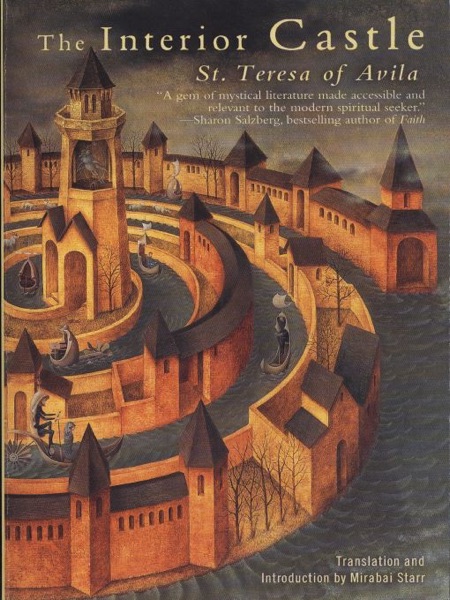
Talk to The Interior Castle like its author wrote you back.
Get the ideas that fit your life — not generic summaries.
- Chat with the book
- Audiobook-style main ideas
- Adapts to your life and goals
- Helps you take action
What it argues
The Interior Castle was written in 1577, when Teresa of Ávila was sixty-two and had already spent decades as a Carmelite reformer. She wrote it under obedience to her confessor and completed the draft in less than a year. The organizing metaphor is a castle made entirely of crystal or clear diamond, representing the soul, with many rooms or dwelling places arranged in concentric circles around a central chamber where God dwells. The book is a map of the soul's journey through these dwelling places toward union with God — both the most systematic and the most experientially grounded of Teresa's major works.
The first three dwelling places describe souls caught in ordinary distraction — preoccupied with the world, just beginning to pray, or making early but uncertain progress in self-knowledge and humility. Teresa is candid about the dangers at each stage: spiritual pride, attachment to consolations, and the mistake of measuring progress by feelings rather than by the growth of virtues. Her tone throughout is direct and occasionally sharp; she has little patience for spiritual vanity.
What it gets right
- 1.
The soul is a castle with many rooms. The spiritual life is a journey inward through dwelling places toward the center where God is present.
- 2.
Self-knowledge is the first and ongoing requirement. Without it, a person cannot proceed — but Teresa warns against navel-gazing that substitutes self-analysis for action.
- 3.
Prayer progresses from acquired (what we do through effort) to infused (what God gives). Teresa insists the transition cannot be forced, and attempting to force it is a common mistake.
What it covers
Who wrote it
Teresa of Ávila (1515–1582) was a Spanish Carmelite nun, mystic, and reformer who founded the Discalced Carmelite order and wrote extensively on contemplative prayer. Her major works include The Way of Perfection, The Interior Castle, and her autobiography The Life. She was declared a Doctor of the Church in 1970 — one of the first women to receive that designation. Her combination of practical organizational ability and deep mystical experience is unusual in the Western spiritual tradition, and her writings remain among the most influential accounts of contemplative prayer in any language.
