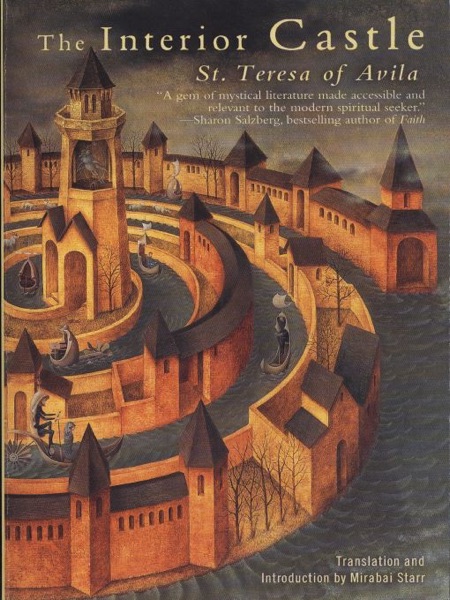
The Interior Castle by Teresa of Ávila is a 1577 religion & spirituality book about prayer, contemplation, mystical union. The soul is a castle with many rooms. The spiritual life is a journey inward through dwelling places toward the center where God is present.
Summary
The Interior Castle was written in 1577, when Teresa of Ávila was sixty-two and had already spent decades as a Carmelite reformer. She wrote it under obedience to her confessor and completed the draft in less than a year. The organizing metaphor is a castle made entirely of crystal or clear diamond, representing the soul, with many rooms or dwelling places arranged in concentric circles around a central chamber where God dwells. The book is a map of the soul's journey through these dwelling places toward union with God — both the most systematic and the most experientially grounded of Teresa's major works.
The first three dwelling places describe souls caught in ordinary distraction — preoccupied with the world, just beginning to pray, or making early but uncertain progress in self-knowledge and humility. Teresa is candid about the dangers at each stage: spiritual pride, attachment to consolations, and the mistake of measuring progress by feelings rather than by the growth of virtues. Her tone throughout is direct and occasionally sharp; she has little patience for spiritual vanity.
The fourth through sixth dwelling places are where the book becomes most distinctive. Teresa describes a transition from "acquired" prayer — what a person does through effort — to "infused" contemplation, which she insists is a gift given by God and cannot be manufactured. She uses two fountains as an image: one fills its basin by channeling water from a distance through effort and technology; the other is fed directly from a spring at its source. The first represents the kind of prayer anyone can learn; the second describes what begins to happen as God draws the soul deeper. The fifth dwelling describes spiritual betrothal and union in brief, intense episodes. The sixth is a long account of the trials — interior and exterior, including what she calls the Prayer of Union and the experiences of locutions and visions — that accompany deepening mystical experience.
The seventh and final dwelling describes "spiritual marriage," the fullest union available in this life. Here Teresa says something surprising: the fruits of this union are not primarily interior peace but increased effectiveness in service. The soul most united with God is the soul most capable of action in the world. The Interior Castle is not an escape from the active life but a foundation for it.
Talk to The Interior Castle like its author wrote you back.
Get the ideas that fit your life — not generic summaries.
- Chat with the book
- Audiobook-style main ideas
- Adapts to your life and goals
- Helps you take action
Key takeaways
- 1.
The soul is a castle with many rooms. The spiritual life is a journey inward through dwelling places toward the center where God is present.
- 2.
Self-knowledge is the first and ongoing requirement. Without it, a person cannot proceed — but Teresa warns against navel-gazing that substitutes self-analysis for action.
- 3.
Prayer progresses from acquired (what we do through effort) to infused (what God gives). Teresa insists the transition cannot be forced, and attempting to force it is a common mistake.
- 4.
Consolations and spiritual feelings are not reliable measures of progress. Virtues — humility, charity, detachment — are the actual evidence of growth.
- 5.
The sixth dwelling describes intense trials: spiritual dryness, social criticism, mysterious locutions and visions. Teresa treats suffering as part of the path rather than evidence of abandonment.
- 6.
Spiritual marriage, the seventh dwelling, is not a state of permanent ecstasy. It is characterized by steady peace, freedom from excessive self-concern, and increased capacity for action.
- 7.
Teresa's two-fountain image distinguishes effortful, mediated prayer from prayer that arises directly from God's presence. The second is a gift, not an achievement.
- 8.
The highest mystical state produces not withdrawal from the world but deeper engagement with it. Union with God is tested and expressed in ordinary service.
Discussion questions
Use these on your own, with a book club, or as chat starters in Superbook. Book club version, ready to copy or print →
- 1.
Teresa uses the image of a castle of clear diamond to represent the soul. What does that metaphor suggest about how she thinks human beings are constituted?
- 2.
She insists on self-knowledge as the starting point but warns against excessive introspection. Where is the line between necessary self-examination and paralyzing self-analysis?
- 3.
Teresa distinguishes acquired from infused prayer. If contemplation cannot be manufactured, what role does spiritual practice actually play in reaching it?
- 4.
The early dwelling places describe souls distracted by the world, pulled back toward the 'moat.' Does her diagnosis of distraction resonate with anything in your own experience of trying to focus on what matters?
- 5.
Teresa claims that consolations — good feelings in prayer — are not evidence of progress, and their absence is not evidence of failure. How do you evaluate your own progress in any serious long-term endeavor?
- 6.
The sixth dwelling includes harsh trials: interior suffering, misunderstanding by others, mysterious experiences. Why does Teresa think suffering deepens rather than interrupts spiritual development?
- 7.
She says the fruits of spiritual union are not primarily interior peace but increased effectiveness in love and service. Does that claim surprise you — and does it match how you think about contemplative practice?
- 8.
Teresa wrote under obedience to a male confessor, in a context where women mystics were viewed with suspicion by the Inquisition. How does that constraint shape the book's rhetoric?
- 9.
The Interior Castle maps a journey of seven stages. Do you think developmental models of spiritual growth are useful — or do they introduce a kind of spiritual competition?
- 10.
Which of Teresa's images — the castle, the two fountains, the silkworm and the butterfly — do you find most illuminating?
- 11.
Teresa is insistent that this path is open to everyone, not only to cloistered nuns. Do you find that claim convincing — or does the life she describes require institutional conditions most people don't have?
- 12.
How does The Interior Castle compare to secular accounts of peak experience, flow states, or meditation in contemporary psychology?
Themes
Frequently asked questions
-
What is The Interior Castle about?
Teresa describes the soul as a crystal castle with many dwelling places. The book is a map of the journey through these places toward union with God, moving from initial distraction and ordinary prayer through increasingly deep states of contemplation to what she calls spiritual marriage.
-
Is The Interior Castle accessible to non-religious readers?
Partially. The psychological descriptions of attention, distraction, and the progression of inner life are precise and often resonate outside a religious context. But the book assumes Christian belief and is explicitly addressed to other Carmelite nuns. Readers outside that frame will find much of value but will also be reading across a significant gap.
-
How long does it take to read The Interior Castle?
Around seven to eight hours for the full text. Teresa's prose is often conversational and digressive — she frequently apologizes for rambling — which makes it slower but also more alive than a formal treatise.
-
What does Teresa mean by infused contemplation?
She means a form of prayer that is given by God rather than produced by the person's effort. The person disposes themselves through practice and humility, but the deeper forms of prayer — what she describes in the fourth through seventh dwellings — cannot be achieved through technique alone.
-
Who should read The Interior Castle?
Readers interested in mystical theology, contemplative practice, or the phenomenology of religious experience. Also useful for anyone studying the history of Christian spirituality or women's intellectual history. It is not primarily a how-to guide — it is more a map for recognition than a set of instructions.