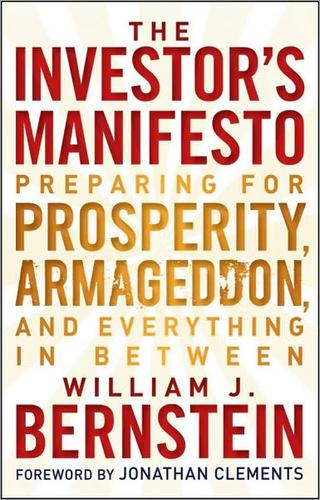
Talk to The Investor's Manifesto like its author wrote you back.
Get the ideas that fit your life — not generic summaries.
- Chat with the book
- Audiobook-style main ideas
- Adapts to your life and goals
- Helps you take action
What it argues
The Investor's Manifesto is William Bernstein's concise statement of what evidence-based investing actually requires. Written in the wake of the 2008 financial crisis, it is both a practical guide and an argument about the structure of the financial industry. Bernstein, a neurologist turned investment theorist, argues that the fundamental facts of investing — expected returns, risk, correlation, rebalancing — are knowable by any careful reader, and that the financial industry profits primarily by exploiting the gap between what most people know and what they need to know.
The first half establishes the theoretical foundation. Expected returns are largely determined by starting valuations and historical risk premiums, not by manager skill. Risk and return are inseparably linked: if an asset promises higher expected returns, it comes with higher volatility or the possibility of permanent loss. Diversification reduces risk without proportionally reducing return — it is, in Bernstein's phrase, "the only free lunch in finance." No combination of fees, selection skill, and market timing can reliably beat a low-cost diversified portfolio over the long term, which means the most rational strategy for most investors is to buy, diversify, and rebalance at minimal cost.
What it gets right
- 1.
Expected returns on any asset are largely determined by starting valuations. High prices today mean lower expected returns going forward; low prices mean higher expected returns.
- 2.
Risk and return cannot be separated. An investment that promises higher returns than its alternatives is carrying higher risk — visible or not.
- 3.
Diversification across uncorrelated assets reduces portfolio risk without proportionally reducing expected return. It is genuinely the only free lunch in investing.
What it covers
Who wrote it
William J. Bernstein is a retired neurologist who became one of the most respected voices in evidence-based investing. He founded Efficient Frontier Advisors and has written extensively on the history of finance and investment theory, including The Four Pillars of Investing, The Birth of Plenty, and A Splendid Exchange. His work is grounded in financial history and academic research rather than market forecasting. Bernstein writes for ordinary investors but does not condescend — his books assume readers can handle data and argument. He lives in the Pacific Northwest.
