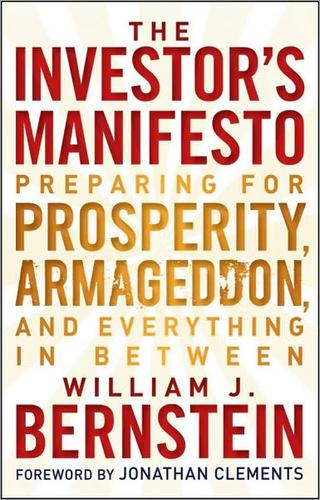
The Investor's Manifesto by William J. Bernstein is a 2009 economics book about investing, asset allocation, market history. Expected returns on any asset are largely determined by starting valuations. High prices today mean lower expected returns going forward; low prices mean higher expected returns.
Summary
The Investor's Manifesto is William Bernstein's concise statement of what evidence-based investing actually requires. Written in the wake of the 2008 financial crisis, it is both a practical guide and an argument about the structure of the financial industry. Bernstein, a neurologist turned investment theorist, argues that the fundamental facts of investing — expected returns, risk, correlation, rebalancing — are knowable by any careful reader, and that the financial industry profits primarily by exploiting the gap between what most people know and what they need to know.
The first half establishes the theoretical foundation. Expected returns are largely determined by starting valuations and historical risk premiums, not by manager skill. Risk and return are inseparably linked: if an asset promises higher expected returns, it comes with higher volatility or the possibility of permanent loss. Diversification reduces risk without proportionally reducing return — it is, in Bernstein's phrase, "the only free lunch in finance." No combination of fees, selection skill, and market timing can reliably beat a low-cost diversified portfolio over the long term, which means the most rational strategy for most investors is to buy, diversify, and rebalance at minimal cost.
The second half addresses the practical implementation of those principles: how to construct a simple portfolio using index funds, how to choose an asset allocation appropriate to one's time horizon and emotional tolerance for loss, and how to evaluate financial advisors. Bernstein is clear-eyed about the financial industry: most advisors' interests are not aligned with their clients', and most actively managed funds do not justify their fees after costs.
The book's tone is measured but occasionally sharp. Bernstein has little patience for the complexity that the industry sells as sophistication. The most important decisions in investing, he argues, are structurally simple: pick a low-cost allocation you can maintain through downturns, rebalance mechanically, and ignore the noise. The execution is the hard part — mostly because the industry and financial media actively work against it.
Talk to The Investor's Manifesto like its author wrote you back.
Get the ideas that fit your life — not generic summaries.
- Chat with the book
- Audiobook-style main ideas
- Adapts to your life and goals
- Helps you take action
Key takeaways
- 1.
Expected returns on any asset are largely determined by starting valuations. High prices today mean lower expected returns going forward; low prices mean higher expected returns.
- 2.
Risk and return cannot be separated. An investment that promises higher returns than its alternatives is carrying higher risk — visible or not.
- 3.
Diversification across uncorrelated assets reduces portfolio risk without proportionally reducing expected return. It is genuinely the only free lunch in investing.
- 4.
Low-cost index funds outperform the majority of actively managed funds over long periods, not because of luck but because costs compound just as returns do.
- 5.
Your asset allocation should match your emotional as well as financial ability to tolerate loss. An allocation you can't hold during a 40% drawdown will cost you more than a lower expected-return allocation you can actually maintain.
- 6.
Rebalancing — selling what has risen and buying what has fallen — is the mechanical discipline that keeps risk on target and forces buying low.
- 7.
Most financial advisors' compensation structures create conflicts of interest. Fee-only fiduciary advisors are structurally better aligned with client interests.
- 8.
The financial media creates urgency around decisions that do not require urgency. The most valuable response to most market news is to do nothing.
Discussion questions
Use these on your own, with a book club, or as chat starters in Superbook. Book club version, ready to copy or print →
- 1.
Bernstein argues expected returns are determined by starting valuations. Given current equity valuations, how does that change your return expectations for the next decade?
- 2.
He says risk and return cannot be separated. Where in your own portfolio are you carrying risks you haven't explicitly acknowledged or priced?
- 3.
What is your actual asset allocation today, and does it reflect a deliberate choice or accumulated drift from investment decisions made at different times?
- 4.
Bernstein's target reader is someone who can manage their own investments simply. Where does simplicity become too simple — what complexity is genuinely worth adding?
- 5.
He argues that most financial advisors' compensation structures work against their clients. How would you evaluate whether your own advisor is a net positive?
- 6.
The book was written in 2009, in the aftermath of a severe crisis. How does that context shape Bernstein's emphasis on behavioral risk and staying the course?
- 7.
Bernstein distinguishes between risk capacity (financial) and risk tolerance (emotional). Which of those is actually the binding constraint for your investment decisions?
- 8.
Rebalancing forces you to sell what's been working and buy what's been lagging. Have you ever actually done this? What made it hard?
- 9.
The book recommends essentially ignoring the financial media. How much of your current investment thinking is influenced by what you've read or watched recently?
- 10.
Bernstein says the financial industry profits from complexity it sells as sophistication. Where else in your financial life are you paying for complexity you don't need?
- 11.
He profiles different investor types by temperament. Which type are you closest to, and how does that affect what a good portfolio design looks like for you?
- 12.
The Manifesto is short and clear. What, if anything, do you think Bernstein has oversimplified or glossed over in the name of accessibility?
Themes
Frequently asked questions
-
Is The Investor's Manifesto worth reading?
Yes, particularly for investors who want a short, evidence-grounded introduction to why low-cost diversified investing outperforms most alternatives. Bernstein writes clearly and doesn't overstate his case. Readers who want depth on the same topics should follow it with The Four Pillars of Investing.
-
How is The Investor's Manifesto different from The Intelligent Investor?
Graham's book is about security analysis and value investing — identifying underpriced individual securities. Bernstein's book argues that security selection is unlikely to outperform for most investors, and that index fund allocation is the rational alternative. They represent different, partly incompatible approaches.
-
What is the main message of The Investor's Manifesto?
That the fundamental knowledge required to invest well is accessible to any careful reader, that low-cost index funds outperform most actively managed alternatives over time, and that the financial industry profits from convincing investors otherwise. Getting the allocation right and maintaining it through downturns is the hard part.
-
How long does it take to read The Investor's Manifesto?
Around four to five hours. It is one of Bernstein's more concise books. The chapters on expected returns and asset allocation reward careful reading; the rest moves quickly.
-
Who should read The Investor's Manifesto?
Investors who want a rigorous but accessible case for passive, diversified investing and who want to understand the financial industry's incentive structure clearly. It is appropriate for beginners who can handle a modest amount of financial data and for experienced investors who want a principled framework to evaluate against their current approach.
Similar books
The Little Book of Common Sense Investing
John C. Bogle
The Bogleheads' Guide to Investing
Taylor Larimore
The Four Pillars of Investing
William J. Bernstein
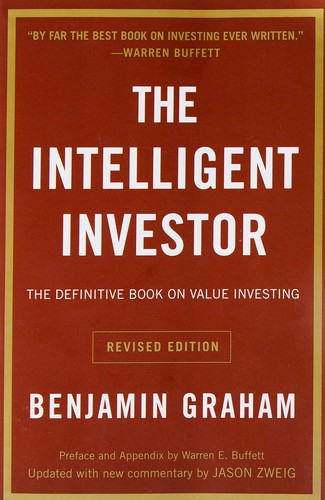
The Intelligent Investor
Benjamin Graham
