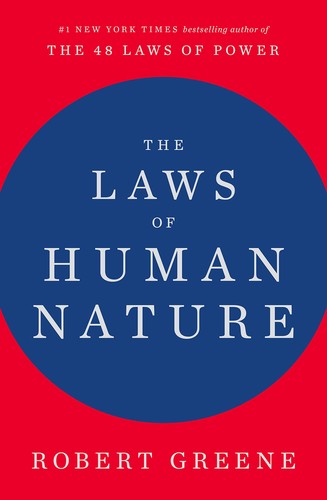
Talk to The Laws of Human Nature like its author wrote you back.
Get the ideas that fit your life — not generic summaries.
- Chat with the book
- Audiobook-style main ideas
- Adapts to your life and goals
- Helps you take action
The Laws of Human Nature, in detail
Robert Greene is a writer whose career has been built on synthesizing historical biography and social observation into frameworks for understanding power, strategy, and human behavior. The Laws of Human Nature, published in 2018, is his most explicitly psychological book — eighteen laws, each covering a fundamental aspect of human behavior that people typically deny, misunderstand, or underestimate.
The book is long and dense. Each chapter opens with an extended historical or biographical case study — Julius Caesar, Eleanor of Aquitaine, Anton Chekhov, Martin Luther King Jr., Daniel Ellsberg — and then develops the law the case illustrates. The laws cover irrationality, narcissism, role-playing, compulsion, covetousness, short-sightedness, and self-sabotage, among others. Greene's approach is Machiavellian in the classical sense: he is interested in understanding how humans actually behave, not how they should behave, and he believes that self-knowledge — including knowledge of one's own shadow, weaknesses, and impulses — is both valuable and rare.
The unifying theme is the gap between how people represent themselves and what actually drives them. Greene argues that most people are considerably less rational, less original, and less aware of their own motivations than they believe. Emotions, early attachments, status concerns, and tribal impulses govern far more behavior than the conscious reasoning that people present publicly. Understanding this — in yourself and in others — is what Greene calls strategic empathy: the ability to model what others are feeling and wanting beneath their stated positions.
The book is not a work of academic psychology. Greene draws on history, biography, and observation more than experimental research. Some of the laws are too broad to be falsifiable, and the confident tone sometimes overstates how much certainty can be had about human nature. But as a synthesis of observations about human behavior across contexts and centuries, aimed at producing self-awareness and practical wisdom rather than academic precision, it is unusual and often illuminating.
The big ideas
- 1.
Rationality is the exception, not the rule. Emotional and irrational motivations drive most human behavior, and the rational explanations people give for their actions are often post-hoc constructions.
- 2.
The shadow self — the parts of your character you deny and project onto others — shapes your behavior from below awareness. Acknowledging it is more productive than suppressing it.
- 3.
Narcissism exists on a spectrum and is present to some degree in everyone. Understanding how narcissistic behavior escalates allows you to work with rather than against the people you depend on.
