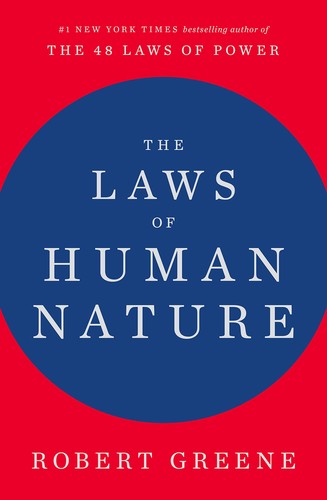
The Laws of Human Nature by Robert Greene is a 2018 psychology book about human nature, social dynamics, self-knowledge. Rationality is the exception, not the rule. Emotional and irrational motivations drive most human behavior, and the rational explanations people give for their actions are often post-hoc constructions.
Summary
Robert Greene is a writer whose career has been built on synthesizing historical biography and social observation into frameworks for understanding power, strategy, and human behavior. The Laws of Human Nature, published in 2018, is his most explicitly psychological book — eighteen laws, each covering a fundamental aspect of human behavior that people typically deny, misunderstand, or underestimate.
The book is long and dense. Each chapter opens with an extended historical or biographical case study — Julius Caesar, Eleanor of Aquitaine, Anton Chekhov, Martin Luther King Jr., Daniel Ellsberg — and then develops the law the case illustrates. The laws cover irrationality, narcissism, role-playing, compulsion, covetousness, short-sightedness, and self-sabotage, among others. Greene's approach is Machiavellian in the classical sense: he is interested in understanding how humans actually behave, not how they should behave, and he believes that self-knowledge — including knowledge of one's own shadow, weaknesses, and impulses — is both valuable and rare.
The unifying theme is the gap between how people represent themselves and what actually drives them. Greene argues that most people are considerably less rational, less original, and less aware of their own motivations than they believe. Emotions, early attachments, status concerns, and tribal impulses govern far more behavior than the conscious reasoning that people present publicly. Understanding this — in yourself and in others — is what Greene calls strategic empathy: the ability to model what others are feeling and wanting beneath their stated positions.
The book is not a work of academic psychology. Greene draws on history, biography, and observation more than experimental research. Some of the laws are too broad to be falsifiable, and the confident tone sometimes overstates how much certainty can be had about human nature. But as a synthesis of observations about human behavior across contexts and centuries, aimed at producing self-awareness and practical wisdom rather than academic precision, it is unusual and often illuminating.
Talk to The Laws of Human Nature like its author wrote you back.
Get the ideas that fit your life — not generic summaries.
- Chat with the book
- Audiobook-style main ideas
- Adapts to your life and goals
- Helps you take action
Key takeaways
- 1.
Rationality is the exception, not the rule. Emotional and irrational motivations drive most human behavior, and the rational explanations people give for their actions are often post-hoc constructions.
- 2.
The shadow self — the parts of your character you deny and project onto others — shapes your behavior from below awareness. Acknowledging it is more productive than suppressing it.
- 3.
Narcissism exists on a spectrum and is present to some degree in everyone. Understanding how narcissistic behavior escalates allows you to work with rather than against the people you depend on.
- 4.
Role-playing is pervasive. People adopt personas suited to their context and audience, and the persona is often more stable than the 'authentic' self beneath it. Watching how people play their roles reveals what they want.
- 5.
Compulsive behavior comes from unresolved early patterns that reassert themselves in later life. Recognizing your own compulsions — and others' — allows you to anticipate rather than be surprised by them.
- 6.
Covetousness is a fundamental driver. People want what others have, and what seems most valuable is often what is currently withheld or scarce. Creating desire in others by withholding is a consistent pattern across relationships and markets.
- 7.
Short-sightedness is the default. Humans discount the future heavily and are systematically surprised by the long-term consequences of short-term decisions. Historical thinking — developing a longer time horizon — is a discipline that pays.
- 8.
Strategic empathy — genuinely modeling what others are feeling and needing, rather than projecting your own perspective — is rare and produces disproportionate social advantage.
Discussion questions
Use these on your own, with a book club, or as chat starters in Superbook. Book club version, ready to copy or print →
- 1.
Greene argues that most people are less rational than they believe. Do you think of yourself as primarily rational? Where does that self-assessment most consistently fail?
- 2.
The shadow self concept comes from Jungian psychology. Can you identify a quality you consistently criticize in others that may be a projection of something in yourself?
- 3.
He applies long case studies from history to each law. Which historical figure's pattern most closely resembles someone you have known or worked with?
- 4.
The book is explicitly about understanding human nature in order to navigate it strategically. Is that orientation compatible with genuine ethical relationships, or does the strategic frame undermine something important?
- 5.
Greene emphasizes the role of early formative experiences in producing adult compulsions and patterns. Do you see clear lines from your own early experience to patterns in your adult behavior?
- 6.
Narcissism as a spectrum means everyone has some. How do you calibrate your assessment of narcissistic behavior in people you depend on, and what do you adjust in response?
- 7.
The law on role-playing suggests that the persona is often more consistent than the self beneath it. What role do you most consistently play, and how much of your behavior in that role do you actually experience as authentic?
- 8.
Strategic empathy requires modeling what others feel rather than projecting your own state. Who in your life do you understand most clearly in this way, and who are you most prone to misreading?
- 9.
The book is very long. Which three or four laws did you find most illuminating, and which felt most like over-extension of a limited observation?
- 10.
Greene writes from outside academic psychology. Does that make the book more or less useful for understanding human behavior than a more rigorous academic treatment would be?
- 11.
He argues that short-sightedness is the default and that historical thinking builds a longer time horizon. What decisions in your current life are most shaped by short-sightedness?
Themes
Frequently asked questions
-
Is The Laws of Human Nature an academic psychology book?
No. It draws on history, biography, and observation rather than experimental research. Greene synthesizes insights from literature, history, and social observation, not the laboratory. This makes it readable and broad but less rigorous than academic psychology.
-
Is this book manipulative in its intent?
Greene writes to help people understand human nature, including their own. Understanding how compulsion, covetousness, and narcissism work is presented as self-protective and potentially empathetic, not primarily as a manual for exploitation. The strategic framing, however, makes that interpretation available.
-
How does this compare to Greene's earlier books like The 48 Laws of Power?
More psychologically sophisticated and less directly strategic. The 48 Laws of Power is prescriptive about power acquisition; The Laws of Human Nature is more interested in self-knowledge and understanding others than in winning. It is also considerably longer.
-
What is the shadow self?
A Jungian concept: the parts of your personality that you have denied, suppressed, or disowned, which nonetheless influence your behavior and which you tend to project onto others. Greene devotes an entire law to working with the shadow rather than suppressing it.
-
Who should read this book?
People interested in human nature through the lens of history and biography rather than experimental psychology. Also useful for anyone navigating complex social environments who wants a framework for reading people more accurately.
Similar books
The Elephant in the Brain: Hidden Motives in Everyday Life
Kevin Simler and Robin Hanson
Mistakes Were Made (But Not by Me)
Carol Tavris and Elliot Aronson
Predictably Irrational
Dan Ariely
Quiet: The Power of Introverts in a World That Can't Stop Talking
Susan Cain
