Talk to The Lean Product Playbook like its author wrote you back.
Get the ideas that fit your life — not generic summaries.
- Chat with the book
- Audiobook-style main ideas
- Adapts to your life and goals
- Helps you take action
The Lean Product Playbook, in detail
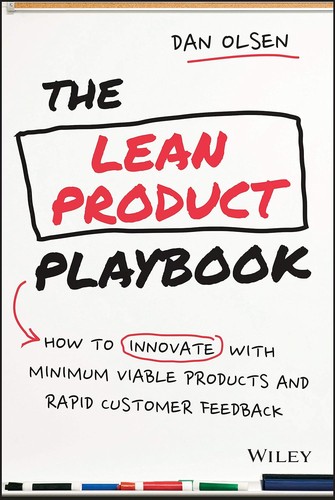
The Lean Product Playbook is Dan Olsen's structured approach to achieving product-market fit — the state in which a product satisfies a real market need well enough to generate sustainable growth. Olsen spent years as a product consultant after product leadership roles at Intuit and several startups, and the book systematizes what he learned: a step-by-step framework called the Lean Product Process that guides teams from customer segment selection through iterative design and testing.
The book's core structure is the Product-Market Fit Pyramid, a hierarchy with five layers: the target customer, their underserved needs, the value proposition, the feature set, and the user experience. The pyramid's key insight is that product teams most commonly make decisions at the top layer (features, UX) while the real failures happen at the bottom (wrong customers, needs that aren't actually underserved, or a value proposition that doesn't differentiate). The process Olsen describes works systematically from the bottom up.
The customer discovery chapters are detailed. Olsen draws a careful distinction between user behavior (what people actually do), user pain points (what frustrates them), and user needs (the underlying goals they are trying to accomplish). The Jobs-to-be-Done framework appears here, but Olsen integrates it with importance-satisfaction analysis — a quantitative method for identifying which needs are high-importance and low-satisfaction, the space where product opportunities actually live.
The second half of the book covers prototyping and testing. Olsen distinguishes between qualitative and quantitative methods and explains when each applies: qualitative testing is appropriate when you need to understand why something is or isn't working; quantitative testing is needed when you need to measure how often something happens. The common failure is substituting one for the other — either launching without quantitative validation or running A/B tests without qualitative understanding of what you're actually measuring.
The book is practical rather than visionary. It does not promise that following the process will guarantee success, and it is clear that product-market fit is a hypothesis that must be tested against real customers rather than a milestone that can be declared internally. As a reference for product managers and founders trying to build products that people actually want, it is one of the more thorough and concrete guides available.
The big ideas
- 1.
Product-market fit is a measurable hypothesis, not a feeling. Olsen's framework makes it tractable by decomposing it into the five layers of the Product-Market Fit Pyramid.
- 2.
Most product failures happen at the foundation — wrong customer segment or underserved need — not at the UX layer where teams usually focus their effort.
- 3.
Importance-satisfaction analysis identifies real product opportunities: high-importance needs that customers are currently underserved on. That space is where defensible products live.
