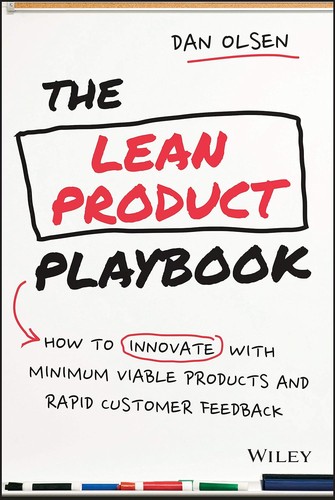
The Lean Product Playbook by Dan Olsen is a 2015 business book about product management, product-market fit, customer discovery. Product-market fit is a measurable hypothesis, not a feeling. Olsen's framework makes it tractable by decomposing it into the five layers of the Product-Market Fit Pyramid.
Summary
The Lean Product Playbook is Dan Olsen's structured approach to achieving product-market fit — the state in which a product satisfies a real market need well enough to generate sustainable growth. Olsen spent years as a product consultant after product leadership roles at Intuit and several startups, and the book systematizes what he learned: a step-by-step framework called the Lean Product Process that guides teams from customer segment selection through iterative design and testing.
The book's core structure is the Product-Market Fit Pyramid, a hierarchy with five layers: the target customer, their underserved needs, the value proposition, the feature set, and the user experience. The pyramid's key insight is that product teams most commonly make decisions at the top layer (features, UX) while the real failures happen at the bottom (wrong customers, needs that aren't actually underserved, or a value proposition that doesn't differentiate). The process Olsen describes works systematically from the bottom up.
The customer discovery chapters are detailed. Olsen draws a careful distinction between user behavior (what people actually do), user pain points (what frustrates them), and user needs (the underlying goals they are trying to accomplish). The Jobs-to-be-Done framework appears here, but Olsen integrates it with importance-satisfaction analysis — a quantitative method for identifying which needs are high-importance and low-satisfaction, the space where product opportunities actually live.
The second half of the book covers prototyping and testing. Olsen distinguishes between qualitative and quantitative methods and explains when each applies: qualitative testing is appropriate when you need to understand why something is or isn't working; quantitative testing is needed when you need to measure how often something happens. The common failure is substituting one for the other — either launching without quantitative validation or running A/B tests without qualitative understanding of what you're actually measuring.
The book is practical rather than visionary. It does not promise that following the process will guarantee success, and it is clear that product-market fit is a hypothesis that must be tested against real customers rather than a milestone that can be declared internally. As a reference for product managers and founders trying to build products that people actually want, it is one of the more thorough and concrete guides available.
Talk to The Lean Product Playbook like its author wrote you back.
Get the ideas that fit your life — not generic summaries.
- Chat with the book
- Audiobook-style main ideas
- Adapts to your life and goals
- Helps you take action
Key takeaways
- 1.
Product-market fit is a measurable hypothesis, not a feeling. Olsen's framework makes it tractable by decomposing it into the five layers of the Product-Market Fit Pyramid.
- 2.
Most product failures happen at the foundation — wrong customer segment or underserved need — not at the UX layer where teams usually focus their effort.
- 3.
Importance-satisfaction analysis identifies real product opportunities: high-importance needs that customers are currently underserved on. That space is where defensible products live.
- 4.
Jobs-to-be-Done framing helps teams avoid building to feature lists by keeping attention on the underlying goal the customer is trying to accomplish.
- 5.
Qualitative and quantitative testing serve different purposes. Qualitative research tells you why; quantitative tells you how often. Confusing the two is a common and costly mistake.
- 6.
A minimum viable product is a learning tool, not a product strategy. The goal is to test hypotheses about value, not to ship something minimal and declare it a product.
- 7.
UX is the top layer of the pyramid, not the starting point. A product with excellent UX but a weak value proposition or an underserved need it doesn't actually address will still fail.
- 8.
Product-market fit is not binary. The pyramid framework allows teams to locate exactly which layer is weak rather than treating the entire product as either succeeding or failing.
Discussion questions
Use these on your own, with a book club, or as chat starters in Superbook. Book club version, ready to copy or print →
- 1.
Which layer of Olsen's Product-Market Fit Pyramid is most commonly weak in products you've worked on or used?
- 2.
The book argues that most product failures happen at the foundation — wrong customer, wrong need — not at the UX level. Does that match your experience or observation?
- 3.
Importance-satisfaction analysis maps needs on two axes. When you think about a product category you use, what high-importance, low-satisfaction needs can you identify?
- 4.
What is the difference between what users say they want in a research interview and what they actually need? How do you close that gap?
- 5.
Olsen is specific about when qualitative vs. quantitative methods apply. Have you seen teams use the wrong method for the question they were trying to answer?
- 6.
The MVP as Olsen describes it is a testing vehicle. How do teams confuse this with a shipping strategy, and what goes wrong?
- 7.
Jobs-to-be-Done framing asks what job a customer is 'hiring' a product to do. Pick a product you use regularly. What job are you hiring it for?
- 8.
Olsen's framework is detailed and step-by-step. What kinds of product work does it handle well, and what falls outside its scope?
- 9.
The book suggests that product-market fit is measurable. What are the most reliable proxies for it that you've seen used in practice?
- 10.
How do you balance rigorous customer discovery against the pressure to ship quickly that most product teams face?
- 11.
Olsen treats user research as a learnable, executable process. Do teams resist this because research is hard, or because it might surface uncomfortable results?
- 12.
What would change in how your organization builds products if the Product-Market Fit Pyramid were applied at the start of every initiative?
Themes
Frequently asked questions
-
What is The Lean Product Playbook about?
It's a structured, step-by-step guide to achieving product-market fit — organized around a framework called the Product-Market Fit Pyramid, which decomposes the problem into five layers from target customer through UX. The book explains how to test hypotheses at each layer systematically.
-
Is this book only for startup founders?
No. It applies to product teams in established companies as much as startups — any situation where a team is trying to determine whether a product genuinely serves a real need. The framework is explicit enough to be useful in large organizations where product decisions often lack rigor.
-
How does The Lean Product Playbook differ from The Lean Startup?
The Lean Startup introduced the build-measure-learn loop and validated learning conceptually. The Lean Product Playbook is more operational — it provides specific methods for customer discovery, hypothesis formation, and testing at each layer of the product stack. They complement each other.
-
How long is The Lean Product Playbook?
About 320 pages — roughly six hours. The chapters map directly to the process steps, so it can be used as a reference alongside active product work rather than read straight through once.
-
What is the most actionable idea in the book?
Importance-satisfaction analysis. Mapping customer needs on the two axes of how important a need is and how well current solutions satisfy it reveals where genuine product opportunities exist — and that mapping is something teams can actually do with relatively simple research.