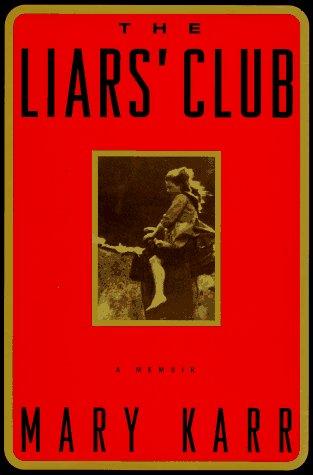
Talk to The Liars' Club like its author wrote you back.
Get the ideas that fit your life — not generic summaries.
- Chat with the book
- Audiobook-style main ideas
- Adapts to your life and goals
- Helps you take action
The Liars' Club, in detail
Mary Karr's debut memoir about growing up in the oil-refinery town of Leechfield, Texas in the 1960s is widely credited with sparking the memoir boom of the 1990s. Published in 1995, it became a bestseller not through a single dramatic revelation but through the accumulation of a particular kind of honesty — about family chaos, about memory's limits, about what children understand and what they construct in the absence of understanding.
The Leechfield Karr portrays is industrial and working-class, a landscape of refineries, bayous, and roadhouses where the men drink hard and the women are defined by how well they survive the men. Her father Pete is a storyteller, a physical laborer, a man of rough warmth who takes young Mary along to his Saturday poker game with friends he calls the Liars' Club — men who tell competitive tall tales — and who represents a kind of stability even at his most volatile. Her mother Charlie is brilliant, troubled, and intermittently dangerous: a woman who had been married multiple times before Pete, who descends into alcoholic breakdowns, and who during one episode destroys the family's possessions with a kitchen knife while the children watch.
Karr withholds the most extreme incident in the memoir — a sexual assault that occurred during a period of breakdown — until the final chapters. This structural choice is not manipulation; it reflects how memory actually works for traumatized children, who understand events only gradually and fragmentarily. The book opens with a cryptic scene of a child being examined by a doctor that the reader can only later decode.
What distinguishes The Liars' Club from later memoir imitators is Karr's prose, which draws on the vernacular richness of East Texas speech, and her ability to render her parents with love and clear eyes simultaneously. She neither excuses nor condemns; she tries to understand. The book is also unusually honest about the limits of memory — she flags what she is unsure of and distinguishes between what she witnessed and what she was later told.
The big ideas
- 1.
Memory is partial and reconstructed. Karr is explicit throughout about what she knows, what she inferred, and what she invented to fill the gaps — an honesty that makes the memoir more trustworthy, not less.
- 2.
Children construct meaning from events they do not understand. The reader often has more information than the child-narrator, and the gap between understanding is the memoir's moral space.
- 3.
Love and damage are not mutually exclusive. Karr's parents were both capable of genuine tenderness and of causing real harm, and the memoir insists on holding both simultaneously.
