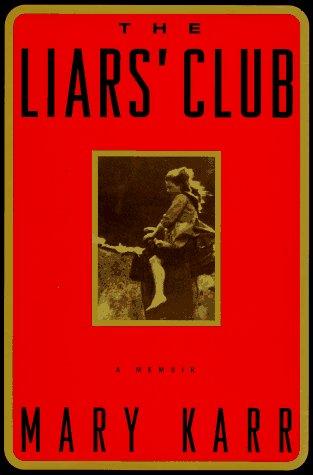
The Liars' Club by Mary Karr is a 1995 memoir book about family, trauma, texas. Memory is partial and reconstructed. Karr is explicit throughout about what she knows, what she inferred, and what she invented to fill the gaps — an honesty that makes the memoir more trustworthy, not less.
Summary
Mary Karr's debut memoir about growing up in the oil-refinery town of Leechfield, Texas in the 1960s is widely credited with sparking the memoir boom of the 1990s. Published in 1995, it became a bestseller not through a single dramatic revelation but through the accumulation of a particular kind of honesty — about family chaos, about memory's limits, about what children understand and what they construct in the absence of understanding.
The Leechfield Karr portrays is industrial and working-class, a landscape of refineries, bayous, and roadhouses where the men drink hard and the women are defined by how well they survive the men. Her father Pete is a storyteller, a physical laborer, a man of rough warmth who takes young Mary along to his Saturday poker game with friends he calls the Liars' Club — men who tell competitive tall tales — and who represents a kind of stability even at his most volatile. Her mother Charlie is brilliant, troubled, and intermittently dangerous: a woman who had been married multiple times before Pete, who descends into alcoholic breakdowns, and who during one episode destroys the family's possessions with a kitchen knife while the children watch.
Karr withholds the most extreme incident in the memoir — a sexual assault that occurred during a period of breakdown — until the final chapters. This structural choice is not manipulation; it reflects how memory actually works for traumatized children, who understand events only gradually and fragmentarily. The book opens with a cryptic scene of a child being examined by a doctor that the reader can only later decode.
What distinguishes The Liars' Club from later memoir imitators is Karr's prose, which draws on the vernacular richness of East Texas speech, and her ability to render her parents with love and clear eyes simultaneously. She neither excuses nor condemns; she tries to understand. The book is also unusually honest about the limits of memory — she flags what she is unsure of and distinguishes between what she witnessed and what she was later told.
Talk to The Liars' Club like its author wrote you back.
Get the ideas that fit your life — not generic summaries.
- Chat with the book
- Audiobook-style main ideas
- Adapts to your life and goals
- Helps you take action
Key takeaways
- 1.
Memory is partial and reconstructed. Karr is explicit throughout about what she knows, what she inferred, and what she invented to fill the gaps — an honesty that makes the memoir more trustworthy, not less.
- 2.
Children construct meaning from events they do not understand. The reader often has more information than the child-narrator, and the gap between understanding is the memoir's moral space.
- 3.
Love and damage are not mutually exclusive. Karr's parents were both capable of genuine tenderness and of causing real harm, and the memoir insists on holding both simultaneously.
- 4.
Place as psychological formation: Leechfield's industrial landscape and working-class culture are not merely backdrop but active conditions that shaped who Karr became.
- 5.
The Liars' Club — Pete's storytelling companions — represents a version of male community and oral tradition that Karr admires even as she names its limitations.
- 6.
Withholding information from the reader can be an act of fidelity to how knowledge actually arrives. Karr's structural choice mirrors the child's experience of understanding retroactively.
- 7.
Prose style is not decorative. Karr's East Texas vernacular voice is itself an argument — that this world and these people deserve literary attention and that working-class speech has its own beauty.
- 8.
The memoir created a template for confession-with-craft that influenced an entire generation of memoirists, for better and worse. Reading Karr now requires distinguishing her from her imitators.
Discussion questions
Use these on your own, with a book club, or as chat starters in Superbook. Book club version, ready to copy or print →
- 1.
Karr describes both parents with complexity and apparent love despite the damage they caused. Do you find that balance convincing, or does it sometimes feel forced?
- 2.
The memoir withholds the worst incident until the final chapters. Does that structural choice feel honest or manipulative? Does the distinction matter?
- 3.
What does the Liars' Club — the storytelling group — represent in the book? Is it purely nostalgic, or does Karr see something complicated in it?
- 4.
Karr's prose is highly stylized, drawing on oral tradition and regional speech. Does the style feel appropriate to the material, or does literary language create a distance from the rawness?
- 5.
The book opens with a scene whose full meaning only becomes clear at the end. Did that structure affect how you read the early chapters on rereading or reflection?
- 6.
How does the memoir handle the difference between what Karr experienced as a child and what she understands as an adult narrator?
- 7.
Charlie, the mother, is a deeply ambivalent figure. How does Karr avoid either pathologizing her or excusing her?
- 8.
The book is set in a specific class context — oil-refinery Texas in the 1960s. How much does class shape the story versus how much is the story universal?
- 9.
The Liars' Club is often credited with starting the memoir boom. What about it might have made other writers think: I can do that with my life?
- 10.
How does Karr handle the ethics of writing about living people — her parents, her sister — who had no control over how they were portrayed?
- 11.
The book ends with a kind of reconciliation scene. Does it feel earned?
Themes
Frequently asked questions
-
Is The Liars' Club a reliable memoir?
Karr is unusually transparent about memory's limits — she flags what she is uncertain about and distinguishes between witnessed and reported events. Her sister disputes some details. The book is honest about its own partiality, which is rarer in memoir than it should be.
-
Is it appropriate for teens?
The book contains depictions of childhood sexual abuse, alcoholism, and mental illness. It is generally considered appropriate for older teens (16+) in guided contexts. It is taught in college courses and adult book clubs.
-
How does The Liars' Club compare to Karr's other memoirs?
Cherry covers her adolescence and is more explicitly about sex and drugs; Lit focuses on her adult alcoholism and conversion to Catholicism. Most readers consider The Liars' Club the strongest of the three, though Lit has its own considerable admirers.
-
What makes the prose distinctive?
Karr draws on East Texas vernacular — the specific rhythms and idioms of working-class Southern speech — and builds sentences that are simultaneously precise and musical. The influence of her poetry training is visible throughout.
-
What was the cultural impact of The Liars' Club?
It is widely credited with sparking the memoir explosion of the mid-1990s. Before it, memoir as a serious literary form was considered marginal; after it, publishers began actively seeking personal narratives. Its influence on the form is difficult to overstate.