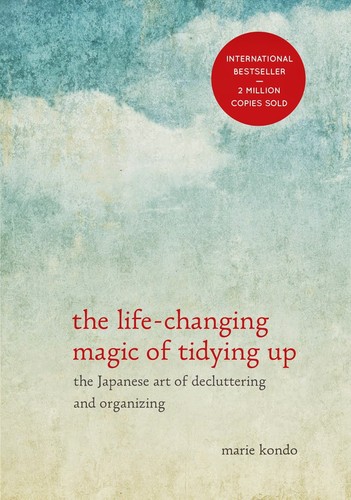
Talk to The Life-Changing Magic of Tidying Up like its author wrote you back.
Get the ideas that fit your life — not generic summaries.
- Chat with the book
- Audiobook-style main ideas
- Adapts to your life and goals
- Helps you take action
What it argues
Marie Kondo's premise is that disorganization is not a logistics problem but a decision problem. People live surrounded by things they neither use nor love because they've never made an explicit choice about whether to keep them. The KonMari method is a protocol for making those choices, once and completely, so the default state of your home is order rather than accumulation.
The method has two organizing principles. First, declutter by category rather than by room. Kondo's sequence is clothes, then books, then papers, then miscellaneous, then sentimental items. Working this way surfaces how many duplicates you own across locations and makes the volume of each category visible. Second, the decision criterion is simple: does this object spark joy? If not, thank it and let it go. Kondo anthropomorphizes possessions with a seriousness that strikes some readers as charming and others as strange, but the underlying logic is practical — the question cuts through the "but I might need it someday" avoidance that keeps closets full of things people don't actually want.
What it gets right
- 1.
Declutter by category, not by room. Gathering every item in one category at once reveals the true scale of your possessions and prevents dispersal across the house.
- 2.
The decision criterion — does this spark joy? — is simple enough to apply consistently and hard to rationalize around.
- 3.
Sentimental items should be handled last, after you've developed discernment through easier categories.
What it covers
Who wrote it
Marie Kondo is a Japanese organizing consultant and the founder of the KonMari method. She began her career as a professional organizer in Tokyo and developed her approach over years of client work. The Life-Changing Magic of Tidying Up, first published in Japan in 2011, became an international bestseller and was followed by Spark Joy, a companion guide with more detail on folding and storage. She has also hosted a Netflix series, Tidying Up with Marie Kondo, which brought the method to a broader audience.
