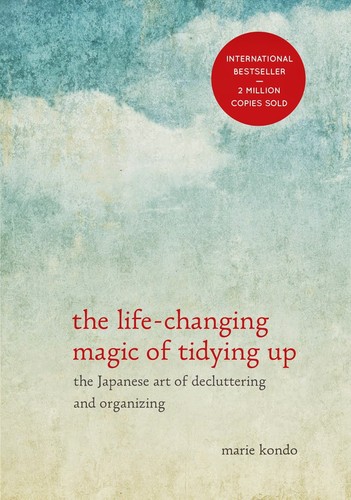
The Life-Changing Magic of Tidying Up by Marie Kondo is a 2014 self-help book about decluttering, minimalism, simplicity. Declutter by category, not by room. Gathering every item in one category at once reveals the true scale of your possessions and prevents dispersal across the house.
Summary
Marie Kondo's premise is that disorganization is not a logistics problem but a decision problem. People live surrounded by things they neither use nor love because they've never made an explicit choice about whether to keep them. The KonMari method is a protocol for making those choices, once and completely, so the default state of your home is order rather than accumulation.
The method has two organizing principles. First, declutter by category rather than by room. Kondo's sequence is clothes, then books, then papers, then miscellaneous, then sentimental items. Working this way surfaces how many duplicates you own across locations and makes the volume of each category visible. Second, the decision criterion is simple: does this object spark joy? If not, thank it and let it go. Kondo anthropomorphizes possessions with a seriousness that strikes some readers as charming and others as strange, but the underlying logic is practical — the question cuts through the "but I might need it someday" avoidance that keeps closets full of things people don't actually want.
The book is also about the psychological weight of clutter. Kondo argues that the things you keep but don't use or love create a subtle drag — they require maintenance, occupy visual space, and carry the emotional residue of past decisions. A cleared space, by contrast, makes what you care about more visible. This is partly why the method has resonated far beyond Japan: it frames tidying not as a chore but as a single decisive act that changes how you experience your home and, Kondo claims, your life.
The limits of the book are real. Kondo writes from a Japanese apartment context, and readers with larger homes, families, or different relationships to possessions may find the prescriptions too rigid or precious. The claim that a tidy home transforms your career and relationships is asserted more than argued. But as a method for making explicit decisions about physical belongings, it is unusually clear and actionable.
Talk to The Life-Changing Magic of Tidying Up like its author wrote you back.
Get the ideas that fit your life — not generic summaries.
- Chat with the book
- Audiobook-style main ideas
- Adapts to your life and goals
- Helps you take action
Key takeaways
- 1.
Declutter by category, not by room. Gathering every item in one category at once reveals the true scale of your possessions and prevents dispersal across the house.
- 2.
The decision criterion — does this spark joy? — is simple enough to apply consistently and hard to rationalize around.
- 3.
Sentimental items should be handled last, after you've developed discernment through easier categories.
- 4.
Everything you keep needs a specific home. Clutter is deferred decision-making made physical.
- 5.
The KonMari method is done once, completely. Kondo argues that tidying in small batches never resolves the underlying decision backlog.
- 6.
Physical environment shapes mental clarity. A space filled with unchosen things creates low-level cognitive and emotional static.
- 7.
Folding clothes vertically so all items are visible reduces the effect where the bottom layer of a drawer goes unseen and unused.
- 8.
The act of thanking items you discard is not superstition — it's a way of acknowledging past choices honestly before releasing them.
Discussion questions
Use these on your own, with a book club, or as chat starters in Superbook. Book club version, ready to copy or print →
- 1.
Kondo argues that clutter is accumulated decision avoidance. What category of possessions in your home has the most unresolved decisions in it?
- 2.
Have you ever experienced the clarity she describes after clearing a space? What changed in how you used the room?
- 3.
The 'spark joy' criterion works well for some items and feels awkward for others. Where does it break down for you?
- 4.
Kondo recommends doing the full process once rather than tidying incrementally. What would it take to actually commit to that in your home?
- 5.
What's the object you've held onto longest that you know you don't need? What's the story behind keeping it?
- 6.
Her approach is deeply individual — she resists tidying someone else's possessions on their behalf. What does that suggest about the limits of organizing for a household rather than just yourself?
- 7.
The book claims tidying changes your relationship to your career and your future. Do you believe that, or does it feel overstated?
- 8.
How do shared spaces — a home with a partner, children, or roommates — interact with a method built around individual joy?
- 9.
Kondo's category sequence puts sentimental items last. What's the logic, and do you think that ordering matters?
- 10.
Many people report rebound — decluttering and then gradually re-accumulating. What does Kondo say causes this, and do you find her explanation convincing?
- 11.
What would your home look like if every object in it had been chosen deliberately rather than accumulated by default?
- 12.
The KonMari method has been called both liberating and privileged — keeping only what sparks joy is easier when you can afford to replace things. How does that critique land for you?
Themes
Frequently asked questions
-
Is The Life-Changing Magic of Tidying Up worth reading?
Yes, if you feel overwhelmed by possessions or have tried organizing systems that didn't hold. The method is simple and the book is short. Some of Kondo's framing — thanking objects, the magical transformation claims — won't resonate with everyone, but the core practice is practical.
-
How long does it take to read this book?
Around two to three hours. It's under 250 pages and reads quickly. The second half is more prescriptive and practical than the first.
-
What is the KonMari method?
A decluttering approach in which you sort possessions by category (not room), hold each item, ask whether it sparks joy, and discard everything that doesn't. What remains is assigned a specific home.
-
Does the KonMari method actually work?
For the people it works for, it tends to produce lasting results because it requires deciding about everything at once rather than making incremental adjustments. The most common failure mode is starting without finishing the full process, which leaves the underlying decision backlog unresolved.
-
Who shouldn't read this book?
Readers who share a home with a partner or family may find the method hard to apply without full household buy-in. The book also assumes a certain baseline of space and material security — its prescriptions are harder to follow when replacing discarded items is not feasible.