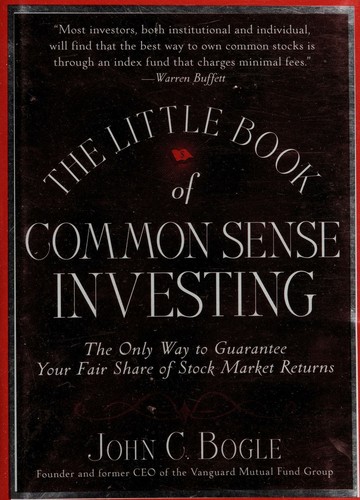
Talk to The Little Book of Common Sense Investing like its author wrote you back.
Get the ideas that fit your life — not generic summaries.
- Chat with the book
- Audiobook-style main ideas
- Adapts to your life and goals
- Helps you take action
What it argues
The Little Book of Common Sense Investing is John Bogle's concise case for why buying the entire stock market through a low-cost index fund is the most rational investment strategy available to most people. Bogle founded Vanguard in 1974 and launched the first retail index fund available to individual investors in 1976. By the time this book was published in 2007, the case was backed by decades of data, and Bogle had spent thirty years watching the fund industry's marketing machinery obscure a simple arithmetic truth.
The core argument is about costs. In aggregate, stock market investors as a group earn exactly the market return before costs — by definition, since they collectively own the market. After costs (management fees, transaction costs, taxes, advisor fees), the aggregate investor earns less than the market. The more active the strategy, the higher the costs. A low-cost index fund captures nearly the entire market return, leaving only a small fraction at the door. An actively managed fund that charges 1-2 percent annually must outperform by that margin just to break even, and evidence shows that most don't.
What it gets right
- 1.
In aggregate, all investors collectively earn the market return before costs. After costs, they earn less. The strategy that minimizes costs therefore wins by arithmetic.
- 2.
A low-cost total stock market index fund captures almost all available market returns and is virtually impossible to consistently beat net of fees over long periods.
- 3.
Most actively managed mutual funds underperform their benchmark index over time, once fees and transaction costs are included. The data on this is abundant and consistent.
What it covers
Who wrote it
John C. Bogle (1929–2019) founded The Vanguard Group in 1974 and launched the first retail index fund for individual investors in 1976, an idea that was widely ridiculed at the time. He served as Vanguard's chairman and CEO until 1996. In addition to The Little Book of Common Sense Investing, he wrote Common Sense on Mutual Funds, Don't Count On It, and The Clash of the Cultures. His persistent advocacy for low-cost investing over five decades reshaped the mutual fund industry, and the shift of trillions of dollars into index funds is largely a product of his influence. Time magazine named him one of the most powerful people in the twentieth century in the field of finance.
