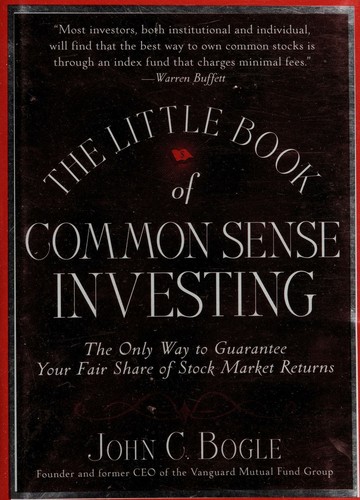
The Little Book of Common Sense Investing by John C. Bogle is a 2007 economics book about index investing, costs and fees, long-term returns. In aggregate, all investors collectively earn the market return before costs. After costs, they earn less. The strategy that minimizes costs therefore wins by arithmetic.
Summary
The Little Book of Common Sense Investing is John Bogle's concise case for why buying the entire stock market through a low-cost index fund is the most rational investment strategy available to most people. Bogle founded Vanguard in 1974 and launched the first retail index fund available to individual investors in 1976. By the time this book was published in 2007, the case was backed by decades of data, and Bogle had spent thirty years watching the fund industry's marketing machinery obscure a simple arithmetic truth.
The core argument is about costs. In aggregate, stock market investors as a group earn exactly the market return before costs — by definition, since they collectively own the market. After costs (management fees, transaction costs, taxes, advisor fees), the aggregate investor earns less than the market. The more active the strategy, the higher the costs. A low-cost index fund captures nearly the entire market return, leaving only a small fraction at the door. An actively managed fund that charges 1-2 percent annually must outperform by that margin just to break even, and evidence shows that most don't.
Bogle walks through the data with characteristic directness: decades of mutual fund performance, survivorship bias that makes the record look better than it is, the failure of past performance to predict future performance, the cost drag from turnover, and the tax inefficiency of active management. The conclusion is relentless — not that every active manager fails, but that identifying which ones will succeed in advance is itself extremely difficult, and that the expected value of trying is negative for most investors after costs.
The prescription follows naturally: buy a total market index fund, keep costs as low as possible, stay invested through market cycles, hold bonds as appropriate for your time horizon, and do not trade. Bogle resists the temptation to add complexity and returns repeatedly to the core point: the arithmetic of costs is the dominant factor in long-run investment outcomes, and most investment activity creates costs without generating returns that justify them.
Talk to The Little Book of Common Sense Investing like its author wrote you back.
Get the ideas that fit your life — not generic summaries.
- Chat with the book
- Audiobook-style main ideas
- Adapts to your life and goals
- Helps you take action
Key takeaways
- 1.
In aggregate, all investors collectively earn the market return before costs. After costs, they earn less. The strategy that minimizes costs therefore wins by arithmetic.
- 2.
A low-cost total stock market index fund captures almost all available market returns and is virtually impossible to consistently beat net of fees over long periods.
- 3.
Most actively managed mutual funds underperform their benchmark index over time, once fees and transaction costs are included. The data on this is abundant and consistent.
- 4.
Past fund performance does not reliably predict future performance. The funds that top the charts in one decade rarely do so in the next.
- 5.
Turnover is a hidden cost. Frequent trading generates commissions and short-term capital gains taxes that reduce net returns without benefiting investors.
- 6.
The magic of compounding works powerfully for costs as well as returns. A 1-2 percent annual fee seems small but compounds into a significant reduction in terminal wealth over 30 years.
- 7.
Stay the course. Investors who sell during market downturns lock in losses and typically miss the recovery. The fund's return and the investor's actual return diverge sharply when investors time the market.
- 8.
Simplicity is a feature, not a failure of ambition. Bogle argues that complexity in investment products almost always benefits the seller more than the buyer.
Discussion questions
Use these on your own, with a book club, or as chat starters in Superbook. Book club version, ready to copy or print →
- 1.
Bogle's arithmetic argument — that all investors collectively earn the market return before costs — is logically inescapable. Why do you think so many people remain convinced they can beat it?
- 2.
What are the actual total costs of your current investments, including management fees, advisor fees, and any transaction costs? Have you ever calculated the long-run impact of those costs?
- 3.
Bogle argues that the investment industry as a whole transfers wealth from investors to itself through fees. Do you think that's an accurate characterization, or is there genuine value being provided?
- 4.
The book was written in 2007. Has the index fund revolution Bogle advocated for actually changed the landscape, or is the industry still structured the same way?
- 5.
Stay the course is Bogle's central behavioral advice. Have you ever sold investments during a market downturn and then watched the market recover without you? What drove that decision?
- 6.
If the evidence for index funds is this clear, why do you think intelligent, educated people still choose active management for a significant portion of their investments?
- 7.
Bogle is dismissive of bond index funds in this book and recommends holding individual bonds. Does that position still make sense to you given current market conditions?
- 8.
The argument applies to most investors most of the time, but Bogle acknowledges exceptions. What characteristics would an investor need to have a genuine edge in active stock selection?
- 9.
How do you think about the role of your investment costs as part of your overall financial plan? Have you optimized costs, or have you focused mainly on returns and diversification?
- 10.
Bogle's approach produces the market return minus a very small cost. Is that satisfying to you emotionally, or does the possibility of beating the market exert a pull even when you intellectually accept the argument?
- 11.
What would change in your investment behavior if you fully accepted Bogle's thesis that identifying future outperforming fund managers is, for most people, not achievable?
- 12.
The book is built around public equity markets. How do Bogle's arguments apply or not apply to other asset classes — private equity, real estate, crypto, alternative investments?
Themes
Frequently asked questions
-
Is The Little Book of Common Sense Investing still relevant?
Very much so. The arithmetic argument for low-cost index investing has only grown stronger as fee data has accumulated over more decades. Bogle's specific examples are dated, but the core logic is as valid as when he first articulated it in 1976.
-
How long does The Little Book of Common Sense Investing take to read?
Around three hours. It is deliberately short and repetitive by design — Bogle wanted the central point to be unmissable. Readers who already understand index investing may find the repetition excessive; first-time readers tend to find it useful.
-
What is Bogle's main recommendation?
Buy a low-cost total stock market index fund, add bonds in proportion to your time horizon and risk tolerance, keep costs as low as possible, stay invested through market cycles, and don't trade. The fewer decisions you make, the better.
-
Does this book tell you which index fund to buy?
Bogle recommends a total stock market index fund as the core holding, with a bond fund component sized to your age and risk tolerance. He does not name specific funds but the implication is clearly Vanguard's offerings. Any total-market index fund from a major low-cost provider fits his criteria.
-
Who should not read this book?
Professional traders, hedge fund managers, and sophisticated investors operating in illiquid or alternative markets will find little applicable here. The book is written for the ordinary individual investor saving for retirement or long-term goals, not for professionals whose edge is specific and institutional.