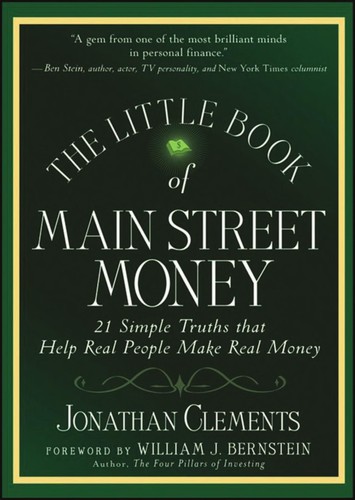
Talk to The Little Book of Main Street Money like its author wrote you back.
Get the ideas that fit your life — not generic summaries.
- Chat with the book
- Audiobook-style main ideas
- Adapts to your life and goals
- Helps you take action
What it argues
The Little Book of Main Street Money is Jonathan Clements's attempt to strip personal finance down to what actually matters for ordinary people — not market timing, not stock picking, not exotic instruments, but the unglamorous fundamentals that determine whether most households build wealth or spend their lives financially fragile. Clements spent nearly two decades writing the personal finance column for the Wall Street Journal, and the book reads like a distillation of everything he concluded was worth telling readers.
The core argument is that personal finance is mostly about behavior, not knowledge. Most people know they should save more and spend less; they know index funds outperform active management over time; they know they should insure against catastrophic risk. What prevents them from doing these things is not ignorance but a collection of emotional tendencies — overconfidence, present bias, loss aversion, the tendency to conflate spending with happiness. Clements names these tendencies directly and offers practical guardrails.
What it gets right
- 1.
Personal finance success is driven more by behavior than by sophisticated financial knowledge — the core principles are simple and widely known.
- 2.
Saving rate matters more than investment returns for most people; increasing savings is a more reliable path to wealth than chasing higher yields.
- 3.
Low-cost index funds outperform the average actively managed fund over long periods after fees; the evidence is overwhelming and largely ignored.
What it covers
Who wrote it
Jonathan Clements wrote the "Getting Going" personal finance column for the Wall Street Journal for nearly two decades and served as director of financial education at Citigroup's Personal Wealth Management division. He is the founder of HumbleDollar, a website focused on practical personal finance guidance. His other books include "25 Myths You've Got to Avoid If You Want to Manage Your Money Right" and "The Little Book of Main Street Money." He is known for applying behavioral research to practical financial decisions for everyday investors.
