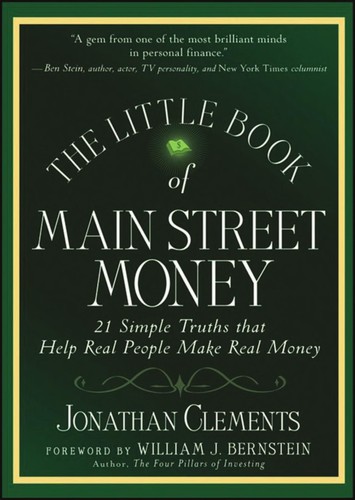
The Little Book of Main Street Money by Jonathan Clements is a 2009 economics book about personal finance, investing, behavioral finance. Personal finance success is driven more by behavior than by sophisticated financial knowledge — the core principles are simple and widely known.
Summary
The Little Book of Main Street Money is Jonathan Clements's attempt to strip personal finance down to what actually matters for ordinary people — not market timing, not stock picking, not exotic instruments, but the unglamorous fundamentals that determine whether most households build wealth or spend their lives financially fragile. Clements spent nearly two decades writing the personal finance column for the Wall Street Journal, and the book reads like a distillation of everything he concluded was worth telling readers.
The core argument is that personal finance is mostly about behavior, not knowledge. Most people know they should save more and spend less; they know index funds outperform active management over time; they know they should insure against catastrophic risk. What prevents them from doing these things is not ignorance but a collection of emotional tendencies — overconfidence, present bias, loss aversion, the tendency to conflate spending with happiness. Clements names these tendencies directly and offers practical guardrails.
The book covers the major financial life stages: building an emergency fund, managing debt, buying versus renting a home, investing for retirement, handling insurance, and spending wisely in retirement. None of the individual advice is surprising to anyone who has read broadly in personal finance. What Clements does well is prioritize: in each area he explains what matters most, what is worth worrying about, and what conventional wisdom gets wrong. His take on housing, for instance, is notably more skeptical than the popular "buy as soon as you can" advice.
This is a short, practical book aimed at people who want reliable guidance without a heavy time investment. It won't teach investing theory in depth, and readers already well-versed in the literature will find limited new material. But for someone who wants a trustworthy condensed guide from a knowledgeable, plain-speaking source, it delivers exactly what the title promises.
Talk to The Little Book of Main Street Money like its author wrote you back.
Get the ideas that fit your life — not generic summaries.
- Chat with the book
- Audiobook-style main ideas
- Adapts to your life and goals
- Helps you take action
Key takeaways
- 1.
Personal finance success is driven more by behavior than by sophisticated financial knowledge — the core principles are simple and widely known.
- 2.
Saving rate matters more than investment returns for most people; increasing savings is a more reliable path to wealth than chasing higher yields.
- 3.
Low-cost index funds outperform the average actively managed fund over long periods after fees; the evidence is overwhelming and largely ignored.
- 4.
Home ownership is not automatically a smart investment — it comes with substantial hidden costs, illiquidity, and concentration risk that buyers routinely underestimate.
- 5.
Insurance should protect against catastrophic financial loss, not small predictable expenses; high-deductible policies that cover tail risks are usually the better choice.
- 6.
Spending has a surprisingly weak relationship to happiness beyond a moderate income level; experiences tend to provide more lasting satisfaction than possessions.
- 7.
The biggest financial mistakes tend to be emotional: panic-selling in downturns, over-trading, and spending to signal status rather than to meet real needs.
- 8.
Automating savings — directing money before you see it — is the most reliable way to overcome the present bias that derails most people's savings plans.
Discussion questions
Use these on your own, with a book club, or as chat starters in Superbook. Book club version, ready to copy or print →
- 1.
Clements argues behavior matters more than knowledge in personal finance. What's the largest gap between what you know you should do and what you actually do?
- 2.
How does your current savings rate compare to what you believe is adequate? What would it take to close that gap by five percentage points?
- 3.
He's skeptical about homeownership as wealth-building. How did you arrive at your own view on buying versus renting, and is it based on numbers or received wisdom?
- 4.
What financial product or practice do you maintain out of habit or convention rather than because you've examined its actual cost-benefit?
- 5.
Clements says spending has a weak link to happiness. Think of a major purchase in the last three years. Does the reality match the anticipated satisfaction?
- 6.
Do you know your total investment costs — the expense ratios and fees across all accounts? What would change if you reduced them by half a percentage point?
- 7.
What insurance do you carry that might be the wrong deductible level or coverage type? When did you last review it?
- 8.
He talks about financial anchors — reference points that distort decisions. What anchors affect how you think about your salary, home value, or portfolio?
- 9.
What financial habit — one specific behavior — would most improve your long-term situation if you changed it this month?
- 10.
How do you handle market downturns emotionally? Has panic or over-optimism ever cost you measurably?
- 11.
Clements writes from the perspective of someone who spent decades watching people make financial mistakes. What financial mistake do you most want to avoid repeating?
Themes
Frequently asked questions
-
Is The Little Book of Main Street Money worth reading?
Yes, particularly for readers who want a reliable, condensed overview from a credible source. Clements writes without conflicts of interest or products to sell. If you're already well-read in personal finance you'll find limited new ground, but the prioritization and clear-headed skepticism about common financial myths make it a useful reference.
-
How long does it take to read The Little Book of Main Street Money?
Around three to four hours. It's under 200 pages and written in short, direct chapters. The format suits readers who want to absorb one or two ideas per sitting rather than reading straight through.
-
What makes this different from other personal finance books?
Clements's two decades writing for the Wall Street Journal gave him an unusual lens: he watched thousands of readers make the same mistakes over and over. The book is less about teaching concepts and more about naming the behavioral traps that derail people who already understand the concepts.
-
Who should read this book?
People in their twenties or thirties who want a comprehensive but brief overview of the major personal finance decisions they'll face — savings, investing, insurance, housing, retirement — without wading through a dense textbook. Also useful for anyone who feels their financial life is not organized but doesn't know where to start.
-
What is the most important idea in the book?
That your savings rate is more controllable and more impactful than your investment returns, and that the best financial move most people can make is to automate savings before they have a chance to spend the money. The rest of investing strategy matters much less than whether savings actually happens.