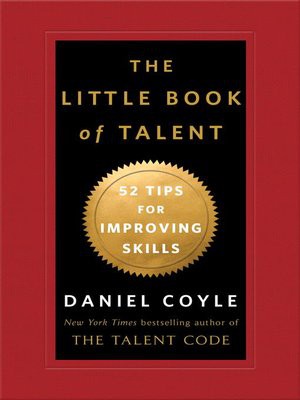
Talk to The Little Book of Talent like its author wrote you back.
Get the ideas that fit your life — not generic summaries.
- Chat with the book
- Audiobook-style main ideas
- Adapts to your life and goals
- Helps you take action
The Little Book of Talent, in detail
The Little Book of Talent is Daniel Coyle's condensed follow-up to The Talent Code, distilling his observations of high-performance training environments into 52 concrete tips. Where The Talent Code explains why deep practice works — it's about myelination, the insulation of neural circuits — this shorter book tells you exactly what to do. Each tip is one to two pages, plain-spoken, and immediately actionable. The book reads more like a coaching manual than a narrative, which is both its strength and its limitation.
Coyle groups the tips into three sections: getting started, improving skills, and sustaining progress. Getting started covers how to choose a role model, how to set up a practice space, and how to build the mental image of what success looks like before you can execute it. The improving skills section is the most practical: it addresses how to chunk a skill into pieces, how to slow down to find your mistakes, and how to practice at the edge of your ability rather than in the comfortable middle. The section on sustaining progress focuses on the psychological habits that keep learners improving when the novelty wears off.
Several tips stand out for their specificity. Coyle recommends stealing the technique of people who are better than you — not their style, but their exact technique for specific sub-skills. He advocates for short, intense sessions over long unfocused ones. And he makes a strong case for what he calls "struggle," the cognitive discomfort of operating at the edge of your current ability, as the actual mechanism of improvement. Practice that feels easy isn't building much.
The book is slim enough to read in a single sitting and dense enough with specific, testable ideas to be useful as a reference. It won't tell you why these methods work in the depth that The Talent Code does, but as a practical field guide to deliberate practice, it delivers what it promises.
The big ideas
- 1.
Talent is built through deep practice: operating at the edge of your ability, making mistakes, correcting them, and repeating. It is not innate.
- 2.
Steal technique, not style. Study the specific mechanics of people better than you at the sub-skills you're trying to build.
- 3.
Short, intense practice sessions beat long, unfocused ones. Twenty minutes of full concentration produces more neural wiring than an hour of going through the motions.
