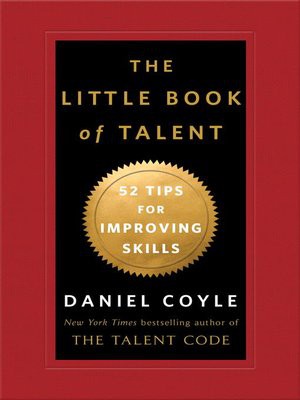
The Little Book of Talent by Daniel Coyle is a 2012 self-help book about skill acquisition, deliberate practice, talent development. Talent is built through deep practice: operating at the edge of your ability, making mistakes, correcting them, and repeating. It is not innate.
Summary
The Little Book of Talent is Daniel Coyle's condensed follow-up to The Talent Code, distilling his observations of high-performance training environments into 52 concrete tips. Where The Talent Code explains why deep practice works — it's about myelination, the insulation of neural circuits — this shorter book tells you exactly what to do. Each tip is one to two pages, plain-spoken, and immediately actionable. The book reads more like a coaching manual than a narrative, which is both its strength and its limitation.
Coyle groups the tips into three sections: getting started, improving skills, and sustaining progress. Getting started covers how to choose a role model, how to set up a practice space, and how to build the mental image of what success looks like before you can execute it. The improving skills section is the most practical: it addresses how to chunk a skill into pieces, how to slow down to find your mistakes, and how to practice at the edge of your ability rather than in the comfortable middle. The section on sustaining progress focuses on the psychological habits that keep learners improving when the novelty wears off.
Several tips stand out for their specificity. Coyle recommends stealing the technique of people who are better than you — not their style, but their exact technique for specific sub-skills. He advocates for short, intense sessions over long unfocused ones. And he makes a strong case for what he calls "struggle," the cognitive discomfort of operating at the edge of your current ability, as the actual mechanism of improvement. Practice that feels easy isn't building much.
The book is slim enough to read in a single sitting and dense enough with specific, testable ideas to be useful as a reference. It won't tell you why these methods work in the depth that The Talent Code does, but as a practical field guide to deliberate practice, it delivers what it promises.
Talk to The Little Book of Talent like its author wrote you back.
Get the ideas that fit your life — not generic summaries.
- Chat with the book
- Audiobook-style main ideas
- Adapts to your life and goals
- Helps you take action
Key takeaways
- 1.
Talent is built through deep practice: operating at the edge of your ability, making mistakes, correcting them, and repeating. It is not innate.
- 2.
Steal technique, not style. Study the specific mechanics of people better than you at the sub-skills you're trying to build.
- 3.
Short, intense practice sessions beat long, unfocused ones. Twenty minutes of full concentration produces more neural wiring than an hour of going through the motions.
- 4.
Slow down to learn faster. Practicing a skill in slow motion allows you to notice and correct errors you'd miss at full speed.
- 5.
Chunk the skill. Break the larger skill into its smallest meaningful pieces and master each one before combining them.
- 6.
Struggle is the signal that learning is happening. If practice feels comfortable and smooth, you are performing rather than improving.
- 7.
Build a vivid mental blueprint of the skill before you can execute it. Watching closely, then attempting, outperforms attempting from scratch.
- 8.
Small daily habits compound. The best performers Coyle observed across sports, music, and other fields all had consistent daily practice rituals rather than sporadic intense sessions.
Discussion questions
Use these on your own, with a book club, or as chat starters in Superbook. Book club version, ready to copy or print →
- 1.
Coyle says talent is built, not born. Where in your life have you assumed someone's skill was natural when it was likely the product of a specific kind of practice?
- 2.
What role model have you studied closely for technique? What would 'stealing their technique' actually look like for a skill you care about?
- 3.
When was the last time practice felt genuinely difficult? Are the things you practice regularly still challenging, or have you settled into the comfortable middle?
- 4.
Think of a skill you haven't improved in years. Is it because you've stopped practicing at the edge of your ability?
- 5.
How do you currently handle mistakes in practice? Do you rush past them or slow down to understand them?
- 6.
Which of Coyle's three sections — getting started, improving skills, or sustaining progress — represents your biggest gap right now?
- 7.
What does your practice environment look like? Does it minimize distraction and signal 'serious work' the way Coyle recommends?
- 8.
Coyle advocates for short, focused sessions. What would change if you cut your current practice time in half but removed all distractions?
- 9.
Where in your life are you confusing performance (doing what you can already do well) with practice (working at the edge of what you can't yet do)?
- 10.
Which skill in your life has the clearest, most concrete sub-skills? Have you identified and isolated those pieces, or do you practice the whole thing at once?
- 11.
Coyle talks about sustaining motivation past the initial excitement. What habits or systems have you built to keep practicing when the novelty has worn off?
Themes
Frequently asked questions
-
Do I need to read The Talent Code before this book?
No. The Little Book of Talent stands on its own as a practical guide. The Talent Code provides the scientific explanation for why these methods work, so reading it adds context, but the tips in this book are self-explanatory and immediately usable without the background.
-
How long is The Little Book of Talent?
Very short — around 160 pages, readable in two hours or less. It's designed to be a field guide you return to rather than read once, and the 52 tips format makes it easy to pick up and apply a specific idea without rereading the whole thing.
-
What is the most actionable tip in the book?
Tip 22 — "Don't Waste Time Practicing Mistakes" — is particularly useful. Coyle recommends stopping the moment you make an error, rewinding, and correcting at slow speed. Most people push through mistakes in practice, which reinforces them. Stopping and correcting breaks the cycle.
-
Who should read The Little Book of Talent?
Anyone who is actively trying to develop a skill: athletes, musicians, programmers, writers, coaches. It's also valuable for parents or teachers looking for evidence-based methods. The broad applicability is one of the book's genuine strengths.
-
Is it just a summary of The Talent Code?
Not quite. While it draws on the same research, The Little Book of Talent goes further into practical application and includes tips that didn't appear in the earlier book. It's better described as a companion than a summary.
Similar books
The Talent Code
Daniel Coyle
Peak: Secrets from the New Science of Expertise
Anders Ericsson and Robert Pool
Grit: The Power of Passion and Perseverance
Angela Duckworth
Ultralearning
Scott Young
