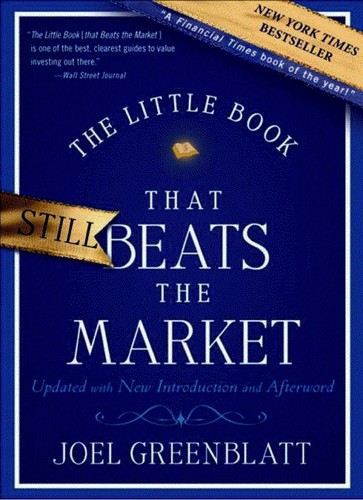
Talk to The Little Book That Still Beats the Market like its author wrote you back.
Get the ideas that fit your life — not generic summaries.
- Chat with the book
- Audiobook-style main ideas
- Adapts to your life and goals
- Helps you take action
What it argues
The Little Book That Still Beats the Market is Joel Greenblatt's attempt to distill value investing into a two-variable formula that any individual investor can run. First published in 2005 and updated in 2010, the book introduces what Greenblatt calls the "magic formula": rank all stocks simultaneously by earnings yield (a measure of cheapness) and return on capital (a measure of quality), then buy the stocks that rank highest on both metrics combined. Hold them for one year, sell, and repeat.
The underlying logic is straightforward. Earnings yield is the inverse of price-to-earnings and measures how cheap a stock is relative to its earnings power. Return on capital measures how efficiently a business converts investment into profit. Greenblatt argues that buying cheap stocks with high returns on capital will, on average, outperform the market over time because other investors systematically undervalue good businesses when they are temporarily out of favor. The formula is not designed to eliminate bad years — it can underperform for two or three years in a row — but the back-tested long-run track record shows meaningful outperformance over the full period Greenblatt examined.
What it gets right
- 1.
The magic formula ranks stocks by both earnings yield and return on capital simultaneously, then buys the stocks scoring highest on both combined.
- 2.
Earnings yield (earnings divided by enterprise value) measures how cheaply you are buying a business's earnings power.
- 3.
Return on capital measures how efficiently a business converts its capital into profit — a proxy for competitive advantage or moat.
What it covers
Who wrote it
Joel Greenblatt is a value investor and founder of Gotham Capital, a hedge fund that produced compound annual returns of approximately 40% over a ten-year period from its founding in 1985. He is a professor at Columbia Business School, where he has taught value investing for decades. His other books include You Can Be a Stock Market Genius and The Big Secret for the Small Investor. He is a trustee of the Success Academy Charter Schools in New York City.
