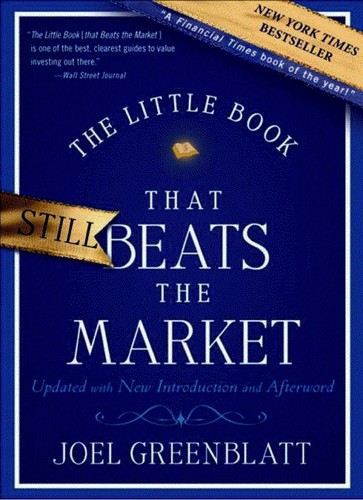
The Little Book That Still Beats the Market by Joel Greenblatt is a 2010 economics book about value investing, quantitative investing, stock screening. The magic formula ranks stocks by both earnings yield and return on capital simultaneously, then buys the stocks scoring highest on both combined.
Summary
The Little Book That Still Beats the Market is Joel Greenblatt's attempt to distill value investing into a two-variable formula that any individual investor can run. First published in 2005 and updated in 2010, the book introduces what Greenblatt calls the "magic formula": rank all stocks simultaneously by earnings yield (a measure of cheapness) and return on capital (a measure of quality), then buy the stocks that rank highest on both metrics combined. Hold them for one year, sell, and repeat.
The underlying logic is straightforward. Earnings yield is the inverse of price-to-earnings and measures how cheap a stock is relative to its earnings power. Return on capital measures how efficiently a business converts investment into profit. Greenblatt argues that buying cheap stocks with high returns on capital will, on average, outperform the market over time because other investors systematically undervalue good businesses when they are temporarily out of favor. The formula is not designed to eliminate bad years — it can underperform for two or three years in a row — but the back-tested long-run track record shows meaningful outperformance over the full period Greenblatt examined.
The book is deliberately simple. Greenblatt wrote it to be accessible to his children; the first half explains the concept of buying good businesses at cheap prices, and the second half explains the mechanical formula and how to implement it. The prose is clear and the examples are concrete. This accessibility is both the book's strength and its limitation — readers looking for nuance in how the formula handles different industries, how it degrades when it becomes widely followed, or what the tax implications of annual turnover are will need to look elsewhere.
The honest caveat Greenblatt himself makes is that the formula requires discipline. The years when it underperforms are the years when investors are most tempted to abandon it. Sticking with a systematic approach through periods of underperformance is harder than it sounds — which is why most investors who try the formula eventually deviate from it at the worst possible moment.
Talk to The Little Book That Still Beats the Market like its author wrote you back.
Get the ideas that fit your life — not generic summaries.
- Chat with the book
- Audiobook-style main ideas
- Adapts to your life and goals
- Helps you take action
Key takeaways
- 1.
The magic formula ranks stocks by both earnings yield and return on capital simultaneously, then buys the stocks scoring highest on both combined.
- 2.
Earnings yield (earnings divided by enterprise value) measures how cheaply you are buying a business's earnings power.
- 3.
Return on capital measures how efficiently a business converts its capital into profit — a proxy for competitive advantage or moat.
- 4.
The formula systematically buys good businesses at temporarily cheap prices, exploiting the tendency of other investors to overreact to short-term problems.
- 5.
Back-tested returns showed significant outperformance over a 17-year period, but the formula can underperform for multiple years consecutively before it works.
- 6.
Mechanical discipline is the entire advantage. Investors who modify the formula in response to short-term underperformance destroy the edge.
- 7.
Any systematic value strategy requires accepting periods of pain. Most people cannot do that, which is why the returns persist for those who can.
Discussion questions
Use these on your own, with a book club, or as chat starters in Superbook. Book club version, ready to copy or print →
- 1.
Greenblatt admits the formula underperformed the market for years at a time in his back-test. Could you hold a mechanical strategy for three years of underperformance without abandoning it? What would make that possible?
- 2.
The magic formula ranks stocks by two variables — earnings yield and return on capital. What variables is it ignoring, and does that concern you?
- 3.
Greenblatt wrote the book partly to teach his children about investing. Does the simplicity he aimed for help or hurt the formula's credibility to you?
- 4.
If many investors use the magic formula, does the edge disappear? How should you think about a strategy that is documented in a bestselling book?
- 5.
Return on capital measures business quality. Can you think of industries where high return on capital is durable versus industries where it quickly attracts competition and erodes?
- 6.
The formula ignores qualitative factors like management quality or industry trends. Are there cases where those factors would clearly override what the formula says?
- 7.
Greenblatt's approach requires buying roughly 20-30 stocks per year and selling them a year later. What are the tax implications of that turnover rate for most investors?
- 8.
The book was written for retail investors, but institutional investors have more data and computing power. Does that change the calculus on whether the formula still works?
- 9.
Greenblatt says most investors can't maintain discipline through underperformance. What does that say about whether passive index investing is a better fit for most people than active formulas?
- 10.
How would you evaluate whether the magic formula is still working if you used it? What evidence would you need to see before abandoning it?
- 11.
The formula treats all companies with similar rankings equally regardless of sector. Does sector neutrality seem like a feature or a limitation to you?
Themes
Frequently asked questions
-
Does the magic formula still work?
The evidence is mixed. Academic studies show that value and quality factors have historically delivered above-market returns, but the premium has compressed since the book was widely read. More importantly, it still requires multi-year discipline through underperformance that most investors cannot maintain.
-
What is the magic formula in simple terms?
Screen for stocks with high earnings yield (cheap price relative to earnings) and high return on capital (efficient business), buy the top-ranked stocks, hold for a year, then repeat. The formula buys good businesses that are temporarily out of favor.
-
How long does it take to read this book?
Around two hours. It is genuinely short and written for a general audience. The first half explains the logic; the second explains implementation. It is one of the most accessible quantitative investing books available.
-
Is The Little Book That Still Beats the Market suitable for beginners?
Yes. It assumes no prior investment knowledge and explains everything from first principles. The main risk is that it makes systematic investing sound easier than it is in practice.
-
Who should not read this book?
Investors who primarily use index funds and are happy with market returns — the formula requires active management, annual turnover, and the discipline to hold through poor years. The tax drag of annual realization may offset some advantage in taxable accounts.
Similar books
The Intelligent Investor
Benjamin Graham
You Can Be a Stock Market Genius
Joel Greenblatt
Common Stocks and Uncommon Profits
Philip A. Fisher
The Essays of Warren Buffett
Warren Buffett
