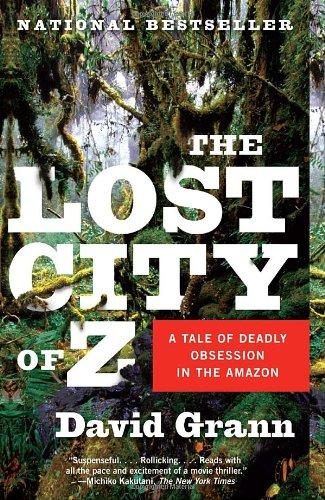
Talk to The Lost City of Z like its author wrote you back.
Get the ideas that fit your life — not generic summaries.
- Chat with the book
- Audiobook-style main ideas
- Adapts to your life and goals
- Helps you take action
The Lost City of Z, in detail
David Grann's account of the British explorer Percy Fawcett's disappearance in the Amazon in 1925 — and of Grann's own journey into the jungle to investigate — is one of the most compelling works of narrative journalism of the 2000s. Fawcett was a larger-than-life Edwardian adventurer who had spent decades mapping the unmapped regions of South America and who became convinced, toward the end of his career, that a lost city of advanced civilization existed somewhere in the Mato Grosso. He called it Z. In 1925 he set off with his son Jack and a friend to find it. None of them was ever seen again.
The book alternates between Fawcett's story — reconstructed from his diaries, letters, and the accounts of people who knew him — and Grann's own investigation, which eventually takes him into the Amazon himself, an experience he approaches with frank anxiety about his sedentary journalist's body and complete lack of wilderness skills. This double narrative is the book's structural cleverness: by placing himself in the jungle, Grann can make visceral the conditions that Fawcett navigated without equipment and with blithe confidence.
Fawcett was a complex figure: a genuine explorer of considerable skill and physical endurance, and also a man whose Victorian certainties about racial hierarchy and the purpose of exploration were characteristic of his era and occasionally horrifying to modern eyes. Grann does not sanitize him. The sections on what the Amazon actually does to human bodies — the parasites, the hunger, the disorientation — give the reader a physical sense of what Fawcett and his successors were attempting.
The book's final section is its most unexpected. Grann's Amazon journey leads him to evidence suggesting that Fawcett may have been looking in more or less the right direction — that the Amazon basin harbored significant pre-Columbian civilizations whose traces are only now being detected through modern archaeology. Z may never have existed as Fawcett imagined it, but the idea behind it was less fantastic than his contemporaries believed. This resolution is tentative and provisional, but it gives the obsession a posthumous vindication.
The big ideas
- 1.
Obsession can produce both disaster and insight. Fawcett's single-minded pursuit of Z destroyed him, but his intuition about Amazonian civilization is now supported by archaeological evidence.
- 2.
The Amazon has consumed hundreds of searchers for Fawcett. Each expedition into the jungle demonstrates what Fawcett was up against and what his searchers underestimated.
- 3.
Pre-Columbian Amazonian civilizations were more complex and extensive than twentieth-century anthropology assumed. The book captures a genuine historical revision in progress.
