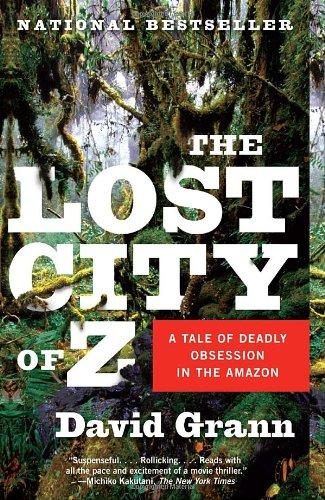
The Lost City of Z by David Grann is a 2009 memoir book about exploration, obsession, amazon. Obsession can produce both disaster and insight. Fawcett's single-minded pursuit of Z destroyed him, but his intuition about Amazonian civilization is now supported by archaeological evidence.
Summary
David Grann's account of the British explorer Percy Fawcett's disappearance in the Amazon in 1925 — and of Grann's own journey into the jungle to investigate — is one of the most compelling works of narrative journalism of the 2000s. Fawcett was a larger-than-life Edwardian adventurer who had spent decades mapping the unmapped regions of South America and who became convinced, toward the end of his career, that a lost city of advanced civilization existed somewhere in the Mato Grosso. He called it Z. In 1925 he set off with his son Jack and a friend to find it. None of them was ever seen again.
The book alternates between Fawcett's story — reconstructed from his diaries, letters, and the accounts of people who knew him — and Grann's own investigation, which eventually takes him into the Amazon himself, an experience he approaches with frank anxiety about his sedentary journalist's body and complete lack of wilderness skills. This double narrative is the book's structural cleverness: by placing himself in the jungle, Grann can make visceral the conditions that Fawcett navigated without equipment and with blithe confidence.
Fawcett was a complex figure: a genuine explorer of considerable skill and physical endurance, and also a man whose Victorian certainties about racial hierarchy and the purpose of exploration were characteristic of his era and occasionally horrifying to modern eyes. Grann does not sanitize him. The sections on what the Amazon actually does to human bodies — the parasites, the hunger, the disorientation — give the reader a physical sense of what Fawcett and his successors were attempting.
The book's final section is its most unexpected. Grann's Amazon journey leads him to evidence suggesting that Fawcett may have been looking in more or less the right direction — that the Amazon basin harbored significant pre-Columbian civilizations whose traces are only now being detected through modern archaeology. Z may never have existed as Fawcett imagined it, but the idea behind it was less fantastic than his contemporaries believed. This resolution is tentative and provisional, but it gives the obsession a posthumous vindication.
Talk to The Lost City of Z like its author wrote you back.
Get the ideas that fit your life — not generic summaries.
- Chat with the book
- Audiobook-style main ideas
- Adapts to your life and goals
- Helps you take action
Key takeaways
- 1.
Obsession can produce both disaster and insight. Fawcett's single-minded pursuit of Z destroyed him, but his intuition about Amazonian civilization is now supported by archaeological evidence.
- 2.
The Amazon has consumed hundreds of searchers for Fawcett. Each expedition into the jungle demonstrates what Fawcett was up against and what his searchers underestimated.
- 3.
Pre-Columbian Amazonian civilizations were more complex and extensive than twentieth-century anthropology assumed. The book captures a genuine historical revision in progress.
- 4.
The Edwardian explorer combined genuine skill and courage with imperial assumptions that shaped what he was looking for and how he treated the people he met.
- 5.
Narrative journalism can be self-aware without being self-indulgent. Grann's account of his own inadequacy as an explorer is both funny and structurally useful.
- 6.
Mystery without resolution is more honest than fabricated closure. The book acknowledges that what happened to Fawcett and his party will probably never be known with certainty.
- 7.
Archives contain more than anyone reads. Grann's research through Fawcett's diaries, the Royal Geographical Society files, and the accounts of previous searchers generates a portrait that no single source could provide.
- 8.
The jungle as adversary is not metaphorical. The physical specifics of the Amazon — the heat, the humidity, the fauna, the disorientation — make the narrative stakes concrete.
Discussion questions
Use these on your own, with a book club, or as chat starters in Superbook. Book club version, ready to copy or print →
- 1.
Fawcett was convinced Z existed. Grann's research suggests something like it may have. Does the book's ambiguous resolution feel satisfying, or does it frustrate you?
- 2.
Grann includes himself as a bumbling narrative presence. Does this self-deprecation serve the story, or does it sometimes feel like a way of avoiding the difficulty of the material?
- 3.
Fawcett held racial views characteristic of his era. How does Grann handle the imperial assumptions of his subject? Does he get the balance right?
- 4.
Many people have died searching for Fawcett. At what point does the search for a missing explorer become irresponsible romanticism?
- 5.
The book argues that the Amazon harbored sophisticated pre-Columbian civilizations. What are the implications of this for how we understand history?
- 6.
Fawcett took his twenty-two-year-old son Jack on the final expedition. What does the book suggest about his responsibility as a father?
- 7.
How does Grann generate tension when the reader already knows Fawcett never came back?
- 8.
The double narrative structure — Fawcett's story and Grann's investigation — is a common device in narrative journalism. Does it work here, or does Grann's story sometimes feel like a distraction?
- 9.
What does the Fawcett story suggest about the relationship between obsession and achievement? Is obsession necessary for important discovery?
- 10.
The indigenous peoples of the Amazon are present throughout the book but not always as full subjects. Does Grann do enough to render them as people rather than obstacles or helpers?
- 11.
The book was adapted into a film. Does that knowledge affect how you imagine the characters?
Themes
Frequently asked questions
-
What happened to Percy Fawcett?
Nobody knows for certain. He and his son Jack and their companion Raleigh Rimell disappeared in the Mato Grosso region of Brazil in 1925. Over the following decades numerous expeditions attempted to find them or their remains; many of those searchers also died or disappeared. No definitive account of their fate has ever been established.
-
Is the Lost City of Z real?
Not in the form Fawcett imagined. But recent archaeological work using LiDAR and other technologies has confirmed extensive pre-Columbian settlements in the Amazon basin that are much more sophisticated than mid-twentieth-century anthropology recognized. Fawcett's intuition may have been partially correct.
-
Do I need to know anything about Amazon exploration to enjoy the book?
No. Grann provides all necessary context. The book is as much a character study and a mystery as a work of exploration history.
-
Is the film adaptation good?
The 2016 film directed by James Gray and starring Charlie Hunnam received positive reviews. Most readers consider the book richer, particularly in its account of the archaeological evidence and Grann's own investigation.
-
How does this compare to Into Thin Air or other adventure narratives?
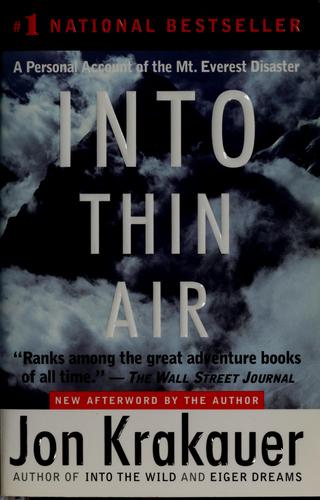
The Lost City of Z is more scholarly and more historically layered than most adventure narratives. Krakauer's Into Thin Air is immediate and first-person throughout; Grann's book weaves historical reconstruction with reported investigation. Both are excellent in different ways.