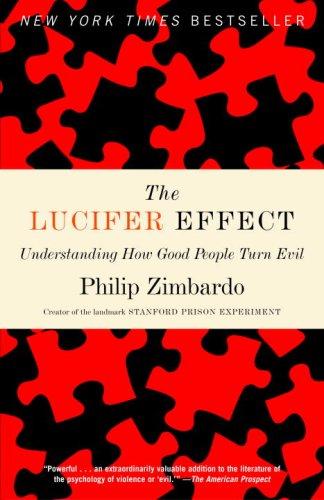
Talk to The Lucifer Effect: Understanding How Good People Turn Evil like its author wrote you back.
Get the ideas that fit your life — not generic summaries.
- Chat with the book
- Audiobook-style main ideas
- Adapts to your life and goals
- Helps you take action
What it argues
Philip Zimbardo designed the Stanford Prison Experiment in 1971, then watched it spin out of control within days. College students randomly assigned to be guards began psychologically tormenting students assigned to be prisoners. The experiment had to be stopped after six days. Zimbardo stopped it partly because his girlfriend — later his wife — came to visit and was horrified by what he saw. He had stopped seeing it clearly. The Lucifer Effect, published in 2007, is his full account of the experiment and the three decades of thinking he had done about what it meant.
Zimbardo's central argument is situationist: most of the behavior we attribute to individual character is actually a response to situational forces. The same person who is kind and ethical under ordinary conditions will, under the right situational pressures, commit cruelties they would have considered unthinkable. This does not mean character is irrelevant — he is not a pure situationist — but it means that our default explanatory move, which is to attribute bad behavior to bad people, is often wrong in a way that matters.
What it gets right
- 1.
The fundamental attribution error leads us to explain bad behavior by attributing it to bad character, when situational forces often explain it better and more accurately.
- 2.
The Stanford Prison Experiment demonstrated that ordinary, psychologically healthy people can commit serious cruelties when placed in roles and environments that license or require them.
- 3.
Situational forces include roles, rules, group norms, authority figures, and the dehumanization of the other. Each operates largely below conscious awareness.
What it covers
Who wrote it
Philip Zimbardo is professor emeritus of psychology at Stanford University, where he taught for more than thirty years. He is best known for designing the Stanford Prison Experiment in 1971, which became one of the most discussed — and most criticized — studies in social psychology. Beyond The Lucifer Effect, he founded the Heroic Imagination Project, which develops programs to promote moral courage. He is the author of The Time Paradox, Shyness, and numerous academic works on social influence, time perspective, and institutional behavior.
