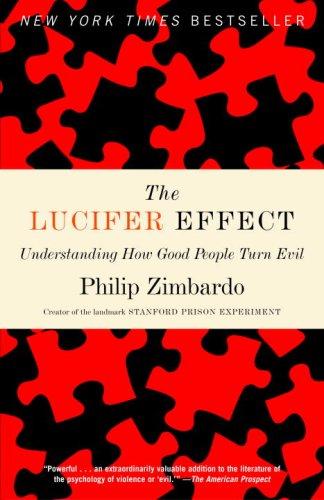
The Lucifer Effect: Understanding How Good People Turn Evil by Philip Zimbardo is a 2007 psychology book about situational behavior, evil, social psychology. The fundamental attribution error leads us to explain bad behavior by attributing it to bad character, when situational forces often explain it better and more accurately.
Summary
Philip Zimbardo designed the Stanford Prison Experiment in 1971, then watched it spin out of control within days. College students randomly assigned to be guards began psychologically tormenting students assigned to be prisoners. The experiment had to be stopped after six days. Zimbardo stopped it partly because his girlfriend — later his wife — came to visit and was horrified by what he saw. He had stopped seeing it clearly. The Lucifer Effect, published in 2007, is his full account of the experiment and the three decades of thinking he had done about what it meant.
Zimbardo's central argument is situationist: most of the behavior we attribute to individual character is actually a response to situational forces. The same person who is kind and ethical under ordinary conditions will, under the right situational pressures, commit cruelties they would have considered unthinkable. This does not mean character is irrelevant — he is not a pure situationist — but it means that our default explanatory move, which is to attribute bad behavior to bad people, is often wrong in a way that matters.
The book spends considerable time on the Abu Ghraib prison abuse scandal, which Zimbardo connected directly to his Stanford research and testified about in the court martial of one of the soldiers. His argument was that the Abu Ghraib abuses were not the work of a few bad apples, as the official account claimed, but of a bad barrel — a situational and systemic environment that predictably generated those behaviors from ordinary people.
The final section turns to heroism: Zimbardo proposes that understanding situational evil implies that heroism — resisting situational pressures toward harm — should be studied, understood, and taught the same way. The book is long and sometimes repetitive, and the Abu Ghraib material can feel like it is making a political argument dressed as psychology. But the situationist challenge to dispositional thinking is real and has significant implications for how institutions, prisons, and systems of accountability are designed.
Talk to The Lucifer Effect: Understanding How Good People Turn Evil like its author wrote you back.
Get the ideas that fit your life — not generic summaries.
- Chat with the book
- Audiobook-style main ideas
- Adapts to your life and goals
- Helps you take action
Key takeaways
- 1.
The fundamental attribution error leads us to explain bad behavior by attributing it to bad character, when situational forces often explain it better and more accurately.
- 2.
The Stanford Prison Experiment demonstrated that ordinary, psychologically healthy people can commit serious cruelties when placed in roles and environments that license or require them.
- 3.
Situational forces include roles, rules, group norms, authority figures, and the dehumanization of the other. Each operates largely below conscious awareness.
- 4.
The Abu Ghraib abuses were not the product of exceptional individuals but of a predictable institutional environment. Understanding this requires examining the system that created the conditions.
- 5.
Deindividuation — the loss of personal identity in a role or group — reduces individual moral agency and increases compliance with group norms, including harmful ones.
- 6.
Obedience to authority is not weakness; it is a deeply wired social instinct. Milgram's research and the Stanford experiment both demonstrate how far ordinary people will go when authority legitimizes harm.
- 7.
Resistance to situational pressures — heroism — is a skill that can be understood, modeled, and taught. The same analysis that explains evil can be applied to the psychology of moral courage.
- 8.
Institutionalized evil requires ordinary people in ordinary roles. The guards at Abu Ghraib were not psychopaths; the SS were not uniformly sadists. Systems and situations matter more than we admit.
Discussion questions
Use these on your own, with a book club, or as chat starters in Superbook. Book club version, ready to copy or print →
- 1.
Zimbardo argues that most evil is situational rather than dispositional. Do you find that argument convincing, and does it change how you think about moral responsibility?
- 2.
He describes how he himself lost perspective as the Stanford Prison Experiment's superintendent. What does that suggest about the possibility of institutional oversight from within a system?
- 3.
The Abu Ghraib parallel is central to the book. Do you think the situationist analysis lets individual actors off the hook, or does it provide a more accurate account of where responsibility actually lies?
- 4.
The fundamental attribution error is the tendency to explain others' behavior by their character. Can you identify a recent case where you made that error?
- 5.
Zimbardo ends with a focus on heroism. What does a psychology of heroism look like, and can it be taught in any practical sense?
- 6.
The experiment was stopped partly because Zimbardo's girlfriend challenged what he was seeing. What does that suggest about the importance of people outside a system in providing moral clarity?
- 7.
If the barrel explanation is correct, what does that imply about how prisons, military units, and other total institutions should be designed?
- 8.
Situationism has been criticized for diminishing individual agency. Where do you think the right balance is between situational and dispositional explanations of behavior?
- 9.
Think of a time you behaved in a way you later found hard to recognize. Can you understand that behavior situationally in Zimbardo's framework?
- 10.
He argues that anonymity and dehumanizing language are specific situational enablers of cruelty. How do you see those factors operating in contemporary contexts?
- 11.
What role does role does the concept of a 'just following orders' defense play in your moral intuitions, and how does the situationist framework complicate or support it?
Themes
Frequently asked questions
-
What happened in the Stanford Prison Experiment?
Twenty-four psychologically healthy male college students were randomly assigned to roles as guards or prisoners in a simulated prison in Stanford's basement. Within two days, guards began abusing prisoners psychologically and physically, and prisoners began breaking down. The experiment was stopped after six days, originally planned to run two weeks.
-
Has the Stanford Prison Experiment been replicated?
Not successfully, and subsequent scrutiny has raised serious methodological concerns. A 2019 investigation by journalist Ben Blum revealed that Zimbardo and others may have coached participants in their roles. The experiment's conclusions remain contested, though situationist psychology more broadly has substantial support.
-
Is Zimbardo excusing the Abu Ghraib abusers?
He argues that situational analysis is not the same as exculpation. Understanding why someone behaved as they did — and that ordinary people under those conditions often would — does not mean they bear no responsibility. It does mean that individual punishment without systemic change is unlikely to prevent recurrence.
-
Is the book worth reading despite its length?
For readers genuinely interested in situationist psychology and moral philosophy, yes. The Abu Ghraib chapters and the early account of the experiment are the most compelling. The book is long and sometimes repetitive, but the core ideas are important.
-
What is the Lucifer Effect?
The title refers to the story of Lucifer, the brightest angel who fell. Zimbardo uses it as a metaphor for the transformation of good people into perpetrators of evil through situational forces — the idea that darkness is not an exceptional trait but a potential in all of us given the wrong conditions.
Similar books
The Laws of Human Nature
Robert Greene
Mistakes Were Made (But Not by Me)
Carol Tavris and Elliot Aronson
The Psychopath Test
Jon Ronson
Behave: The Biology of Humans at Our Best and Worst
Robert M. Sapolsky
