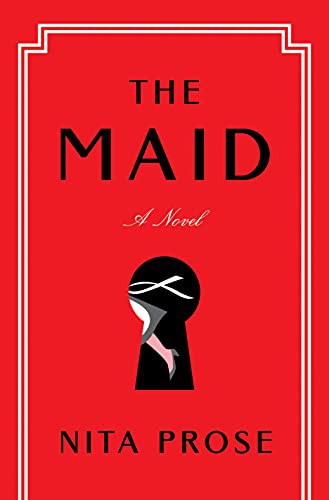
Talk to The Maid like its author wrote you back.
Get the ideas that fit your life — not generic summaries.
- Chat with the book
- Audiobook-style main ideas
- Adapts to your life and goals
- Helps you take action
The Maid, in detail
Molly Gray is a hotel maid at the Regency Grand, and she is exceptionally good at her job. She finds deep satisfaction in making a disordered room orderly, in the precise arrangement of toiletries, in the transformation of a made bed. She is also — as she and everyone around her gradually recognize — neurodivergent in ways that make social interaction reliably confusing. When she discovers a wealthy hotel guest dead in his suite, she becomes the primary suspect, mostly because she doesn't know not to act the way she acts.
The novel is fundamentally a cozy mystery, the first in a series, and it delivers the genre pleasures with genuine craft: a sympathetic detective-figure, a closed world (the luxury hotel), a cast of eccentrics with motives, and a resolution that satisfies. What Prose adds to the formula is a protagonist whose cognitive difference is not a superpower that makes her effortlessly brilliant but a genuine difference that creates real vulnerability and real strength in alternation. Molly misreads social cues, says the wrong things, and is exploited by people who know it. She also sees things other people don't because she pays close attention to what is actually in front of her rather than what is supposed to be there.
Prose writes Molly's voice with warmth and without condescension. The novel is not a case study in neurodivergence — Molly is never identified by a clinical label — but it treats her inner life as fully real and fully worth understanding. Her relationship with her late grandmother, who raised her and gave her the vocabulary for navigating the world, is the novel's emotional anchor. The found-family plot that develops around her — the hotel bartender, the detective who eventually believes her, a bellman — is drawn with genuine affection.
This is feel-good literary fiction in the best sense: it takes its protagonist's interiority seriously, delivers on its genre promises, and earns its warmth through specificity rather than sentiment. Readers who want a sharp-edged thriller will find it too gentle. Readers who want a cozy, funny, emotionally rewarding mystery with a protagonist unlike most will find it one of the more memorable recent examples of the genre.
The big ideas
- 1.
Molly's neurodivergence is neither a handicap to overcome nor a superpower to deploy — it is simply how she experiences the world, and the novel insists that this is a full experience worth portraying.
- 2.
The hotel setting functions as a microcosm: it is a world that runs on appearances and hierarchies, which makes Molly's commitment to what is actually there rather than what should be there a form of radical honesty.
- 3.
The mystery plot is less about whodunit than about how Molly learns to trust her own perception against a world that consistently tells her she has it wrong.
