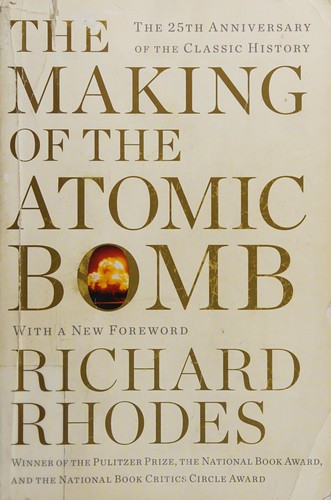
Talk to The Making of the Atomic Bomb like its author wrote you back.
Get the ideas that fit your life — not generic summaries.
- Chat with the book
- Audiobook-style main ideas
- Adapts to your life and goals
- Helps you take action
What it argues
Richard Rhodes spent years researching the scientific and political story behind the Manhattan Project, and the result is a work of narrative history that refuses to treat the bomb as either a triumph or a horror to be judged from a comfortable distance. The Making of the Atomic Bomb won the Pulitzer Prize in 1988 and remains the definitive account of how the most destructive weapon in history was built in under three years.
Rhodes begins with the theoretical physics — the discoveries of radioactivity, fission, and the chain reaction — and renders them accessible without dumbing them down. The scientists who built the bomb are vivid individuals: Leo Szilard conceiving the chain reaction on a London street corner, Enrico Fermi supervising the first controlled reaction beneath a Chicago squash court, Robert Oppenheimer managing an extraordinary collection of egos in the New Mexico desert. Rhodes is as interested in the human story as the technical one, and he follows these men and women from their European origins through emigration, wartime secrecy, and finally the detonations at Alamogordo, Hiroshima, and Nagasaki.
What it gets right
- 1.
The atomic bomb was built by a community of European refugee physicists who brought the theoretical foundations of fission to America just as Hitler was closing universities to Jews.
- 2.
The Manhattan Project succeeded in part because of Robert Oppenheimer's rare ability to manage top-tier scientific talent under extreme secrecy and time pressure.
- 3.
The decision to use the bomb on Japanese cities involved less deliberation than the decision to build it. No single formal review considered alternatives before Hiroshima.
What it covers
Who wrote it
Richard Rhodes is an American author and journalist whose work spans nuclear history, science, and American culture. He has written more than twenty books, including the follow-up volumes Dark Sun (about the hydrogen bomb) and Arsenals of Folly (about the Cold War arms race). The Making of the Atomic Bomb won the Pulitzer Prize for General Nonfiction, the National Book Award, and the National Book Critics Circle Award in 1988. Rhodes has received fellowships from the Guggenheim Foundation and the Alfred P. Sloan Foundation. He lives in Northern California.
