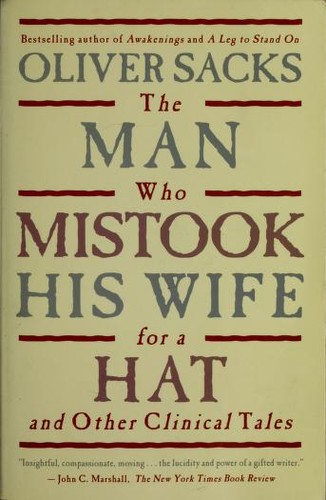
Talk to The Man Who Mistook His Wife for a Hat like its author wrote you back.
Get the ideas that fit your life — not generic summaries.
- Chat with the book
- Audiobook-style main ideas
- Adapts to your life and goals
- Helps you take action
The Man Who Mistook His Wife for a Hat, in detail
Oliver Sacks was a neurologist who thought in stories. This collection of twenty-four case studies, published in 1985, follows patients with unusual neurological conditions — people who cannot recognize faces, who feel their own limbs as foreign objects, who are locked in loops of memory, who possess extraordinary abilities alongside devastating losses. The title case concerns Dr. P., a musician who has lost the ability to recognize objects by sight and reaches for his wife's head thinking it is his hat. Sacks treats the error not as comedy but as a window into what vision actually is.
The book divides into four sections: losses (deficits in the conventional sense), excesses (conditions where something is pathologically amplified), transports (hallucinatory and visionary states), and the world of the simple (people with intellectual disabilities and the capacities they retain). Sacks resists the clinical convention of defining patients by what they lack. His Jimmie G., an amnesiac who cannot form new memories, still experiences the beauty of a garden. His Rebecca, labeled as intellectually deficient, reveals a deep feeling for narrative and poetry. The diagnosis is rarely the whole person.
Sacks draws on Romanticist neurology — the tradition of Luria and Luriya — as a counterpoint to the reductive, defect-cataloguing mainstream. He wants to restore the human subject to neurology. This is a different project from diagnosis. Deficits reveal the architecture of a system only when you also ask what remains intact, what compensates, what the person is doing with the situation they find themselves in.
The cases here have dated in some ways — cognitive neuroscience has moved considerably since 1985 — but Sacks's fundamental questions remain open: What is the self? How much of identity lives in the body and its intact processing? What do we lose when we lose the capacity to situate ourselves in time, or in a body that feels like ours? The Man Who Mistook His Wife for a Hat has stayed in print because it asks those questions with more humility than certainty, and because the people in it are impossible to forget.
The big ideas
- 1.
Neurological damage reveals the normally invisible machinery of the mind. When a faculty breaks, we see what it was doing all along.
- 2.
Deficits and excesses are two sides of the same coin. Pathological amplification of a capacity is as revealing as its absence.
- 3.
Patients are not their diagnoses. Sacks consistently finds preserved capacities, adaptive strategies, and intact humanity in people whose deficits would seem to preclude it.
