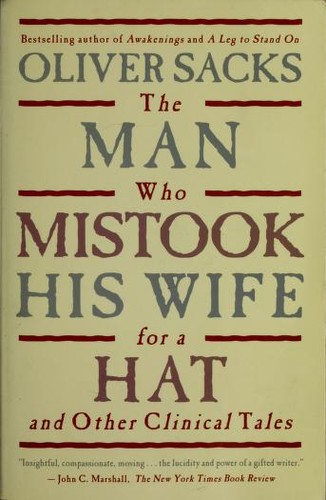
The Man Who Mistook His Wife for a Hat by Oliver Sacks is a 1985 psychology book about neuroscience, identity, perception. Neurological damage reveals the normally invisible machinery of the mind. When a faculty breaks, we see what it was doing all along.
Summary
Oliver Sacks was a neurologist who thought in stories. This collection of twenty-four case studies, published in 1985, follows patients with unusual neurological conditions — people who cannot recognize faces, who feel their own limbs as foreign objects, who are locked in loops of memory, who possess extraordinary abilities alongside devastating losses. The title case concerns Dr. P., a musician who has lost the ability to recognize objects by sight and reaches for his wife's head thinking it is his hat. Sacks treats the error not as comedy but as a window into what vision actually is.
The book divides into four sections: losses (deficits in the conventional sense), excesses (conditions where something is pathologically amplified), transports (hallucinatory and visionary states), and the world of the simple (people with intellectual disabilities and the capacities they retain). Sacks resists the clinical convention of defining patients by what they lack. His Jimmie G., an amnesiac who cannot form new memories, still experiences the beauty of a garden. His Rebecca, labeled as intellectually deficient, reveals a deep feeling for narrative and poetry. The diagnosis is rarely the whole person.
Sacks draws on Romanticist neurology — the tradition of Luria and Luriya — as a counterpoint to the reductive, defect-cataloguing mainstream. He wants to restore the human subject to neurology. This is a different project from diagnosis. Deficits reveal the architecture of a system only when you also ask what remains intact, what compensates, what the person is doing with the situation they find themselves in.
The cases here have dated in some ways — cognitive neuroscience has moved considerably since 1985 — but Sacks's fundamental questions remain open: What is the self? How much of identity lives in the body and its intact processing? What do we lose when we lose the capacity to situate ourselves in time, or in a body that feels like ours? The Man Who Mistook His Wife for a Hat has stayed in print because it asks those questions with more humility than certainty, and because the people in it are impossible to forget.
Talk to The Man Who Mistook His Wife for a Hat like its author wrote you back.
Get the ideas that fit your life — not generic summaries.
- Chat with the book
- Audiobook-style main ideas
- Adapts to your life and goals
- Helps you take action
Key takeaways
- 1.
Neurological damage reveals the normally invisible machinery of the mind. When a faculty breaks, we see what it was doing all along.
- 2.
Deficits and excesses are two sides of the same coin. Pathological amplification of a capacity is as revealing as its absence.
- 3.
Patients are not their diagnoses. Sacks consistently finds preserved capacities, adaptive strategies, and intact humanity in people whose deficits would seem to preclude it.
- 4.
The self is not a single thing. Different cognitive systems contribute to the experience of being a continuous person, and any one can fail independently.
- 5.
Memory is not a recording but a reconstruction. Cases of amnesia show that time, narrative, and identity depend on memory in ways we rarely appreciate until they fail.
- 6.
The body image is constructed, not given. Patients who cannot recognize their own limbs demonstrate that the brain must constantly model the body it inhabits.
- 7.
Abstract intelligence and experiential richness are separable. People with severe cognitive limitations may retain deep emotional and aesthetic responsiveness.
- 8.
Clinical objectivity has costs. Treating a patient as a case can obscure what the person's experience actually is, and what they still are.
Discussion questions
Use these on your own, with a book club, or as chat starters in Superbook. Book club version, ready to copy or print →
- 1.
Sacks writes that we think of the brain in terms of its parts, but patients live in terms of their whole experience. How does that tension play out in the cases you found most affecting?
- 2.
Dr. P. navigates the world through a kind of algorithmic cognition, recognizing objects by feature rather than by seeing them. What does this suggest about what 'seeing' normally involves?
- 3.
Jimmie G. cannot form new memories but still responds to music and beauty. What does his case imply about where the self actually lives?
- 4.
Sacks accuses neurology of being more interested in deficits than in what remains. Do you think that criticism applies more broadly — in medicine, in education, in how we relate to people with disabilities?
- 5.
The section on excesses includes cases of pathologically heightened states — Tourette's, hallucinations, extreme mnemonic ability. How do these cases complicate the idea of 'normal' cognition?
- 6.
Rebecca is described as globally impaired on standard tests but demonstrates a genuine poetic sensibility. What do standard tests measure, and what do they miss?
- 7.
Sacks uses the word 'soul' throughout, in a secular but deliberate way. What do you think he means by it, and do you find that framing useful or problematic?
- 8.
Many of these patients find their own adaptations to their conditions. What does that adaptability suggest about the relationship between damage and identity?
- 9.
Which case in the book stayed with you most, and why? What did it make you think about your own cognition?
- 10.
Sacks was criticized by some for aestheticizing his patients' conditions. Is there a tension between honoring someone's humanity and making them the subject of a readable narrative?
- 11.
The book was written forty years ago. Which aspects feel dated, and which questions seem as open as ever?
- 12.
If you imagine losing one cognitive faculty — memory, spatial recognition, the sense of owning your own body — which loss would feel most like a loss of self, and why?
Themes
Frequently asked questions
-
Is The Man Who Mistook His Wife for a Hat still worth reading?
Yes, though it helps to know that some of the neuroscience has been revised since 1985. The cases themselves remain vivid and the questions Sacks raises — about identity, selfhood, and what it means to be a person — are as open as ever. Read it for the thinking, not as a current clinical reference.
-
How long does it take to read?
Around five hours. The cases range from a few pages to twenty or thirty, and each is self-contained. It works well read in short sessions.
-
What is the main point of the book?
That neurological conditions reveal the normally hidden machinery of the mind, and that patients are not defined by their deficits. Sacks argues for a neurology that treats the whole person and asks what remains intact, not only what is lost.
-
Is it a sad book?
It is serious and occasionally heartbreaking, but Sacks resists pathos. He finds dignity and surprising wholeness in almost every patient he describes. The overall effect is more wonder than grief.
-
Who should read it?
Anyone curious about consciousness, identity, or what the brain actually does. It is also valuable for clinicians, caregivers, and anyone who works with people who have neurological or cognitive differences. The writing is accessible — no neuroscience background required.
Similar books
Incognito: The Secret Lives of the Brain
David Eagleman
Phantoms in the Brain: Probing the Mysteries of the Human Mind
V. S. Ramachandran and Sandra Blakeslee
Descartes' Error: Emotion, Reason, and the Human Brain
Antonio Damasio
Behave: The Biology of Humans at Our Best and Worst
Robert M. Sapolsky
