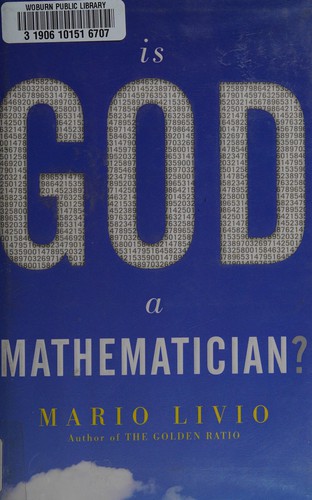
Talk to Is God a Mathematician? like its author wrote you back.
Get the ideas that fit your life — not generic summaries.
- Chat with the book
- Audiobook-style main ideas
- Adapts to your life and goals
- Helps you take action
Is God a Mathematician?, in detail
Mario Livio is an astrophysicist who has spent decades studying galaxies and supernovae, and who has been persistently haunted by a question that comes up whenever mathematics meets physics: why does abstract math, invented centuries before anyone knew it would be needed, keep turning out to perfectly describe physical reality? Physicist Eugene Wigner called this "the unreasonable effectiveness of mathematics," and Livio has written a book-length attempt to understand it.
The first half of the book is a history of mathematical ideas and the people who developed them: the Pythagoreans and their mystical relationship to number, Archimedes and the foundations of calculus, Galileo's decision to describe the world in mathematical language, and the 19th-century development of non-Euclidean geometry, which seemed like pure abstraction until Einstein used it to describe spacetime. Livio traces how mathematics developed partly to describe the world and partly from purely internal concerns — from mathematicians following logical necessity rather than physical observation — and how both strands kept turning out to be useful.
The book's central question is philosophical: is mathematics discovered or invented? Platonists believe mathematical truths exist independently of any mind and we merely uncover them. Formalists believe mathematics is a human construction — a system of symbols and rules that we define and play by. Livio surveys the arguments with care and concludes that neither extreme is satisfying. His preferred answer is that mathematics is a human invention that evolved in close contact with physical reality, which explains why it describes that reality so well while also leaving room for purely abstract mathematics that only later turns out to be useful.
The writing is clear and the history is genuinely interesting, though readers looking for a decisive answer to the title question will be mildly disappointed. Livio is more comfortable raising the question carefully than resolving it. The book is best read as an extended meditation on a genuinely open question in the philosophy of science, one that most scientists don't pause to ask even though it underlies everything they do.
The big ideas
- 1.
Wigner's 'unreasonable effectiveness of mathematics' — the fact that abstract math keeps describing physical reality — is one of the deepest unsolved puzzles in the philosophy of science.
- 2.
The history of mathematics shows repeated cases where purely abstract systems developed for internal mathematical reasons later became the exact language needed for new physics.
- 3.
Non-Euclidean geometry was developed by mathematicians exploring what would happen if Euclid's parallel postulate were denied — and became the mathematical framework for general relativity decades later.
