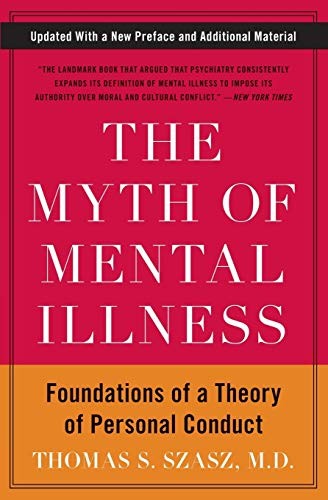
Talk to The Myth of Mental Illness: Foundations of a Theory of Personal Conduct like its author wrote you back.
Get the ideas that fit your life — not generic summaries.
- Chat with the book
- Audiobook-style main ideas
- Adapts to your life and goals
- Helps you take action
What it argues
Thomas Szasz's thesis, first published in 1961, is that mental illness is a category error. Illness, properly understood, is a deviation from a biological norm — a lesion, an infection, a demonstrable structural or biochemical abnormality. Mental illness, by contrast, is defined by deviation from social, ethical, or legal norms. Because the two types of deviation are fundamentally different, calling the second type an "illness" imports medical authority into what is actually a moral and political judgment. Szasz does not deny that people suffer or behave strangely; he denies that their suffering is best understood as disease.
Szasz develops his argument through a close reading of the history of psychiatry, particularly Freudian theory. He argues that Freud's achievement was to create a systematic framework for understanding "problems in living" — difficulties with work, relationships, sexuality, and meaning — but that framing these problems as diseases subject to medical treatment was a category mistake with serious social consequences. Psychiatric diagnosis, he argues, is a tool for social control masquerading as medical science: it allows the state and families to coerce individuals under the neutral-seeming authority of medical necessity.
What it gets right
- 1.
Mental illness is defined by deviation from social and ethical norms, not from biological ones. Calling this type of deviation 'illness' is a category error that imports medical authority into moral judgment.
- 2.
Szasz distinguishes genuine brain diseases with identifiable pathology from functional psychiatric diagnoses that describe unwanted behavior without demonstrable organic cause.
- 3.
Psychiatric diagnosis functions as a tool of social control: it allows families and the state to coerce individuals into treatment using the neutral authority of medical necessity.
What it covers
Who wrote it
Thomas Szasz was an American-Hungarian psychiatrist and professor of psychiatry emeritus at the State University of New York Upstate Medical University. He practiced psychiatry for decades while simultaneously critiquing its philosophical and ethical foundations. His other major works include The Manufacture of Madness, Ideology and Insanity, and Insanity: The Idea and Its Consequences. A committed libertarian, he was a founding member of the Citizens Commission on Human Rights. He died in 2012 at the age of ninety-two.
