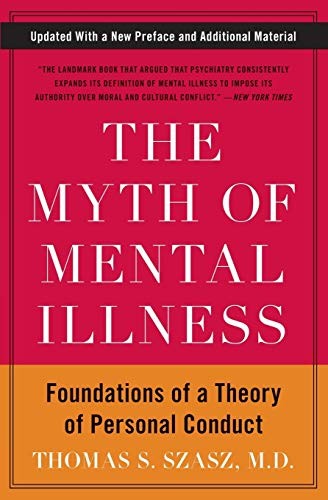
The Myth of Mental Illness: Foundations of a Theory of Personal Conduct by Thomas Szasz is a 1961 psychology book about psychiatry, mental health, ethics. Mental illness is defined by deviation from social and ethical norms, not from biological ones. Calling this type of deviation 'illness' is a category error that imports medical authority into moral judgment.
Summary
Thomas Szasz's thesis, first published in 1961, is that mental illness is a category error. Illness, properly understood, is a deviation from a biological norm — a lesion, an infection, a demonstrable structural or biochemical abnormality. Mental illness, by contrast, is defined by deviation from social, ethical, or legal norms. Because the two types of deviation are fundamentally different, calling the second type an "illness" imports medical authority into what is actually a moral and political judgment. Szasz does not deny that people suffer or behave strangely; he denies that their suffering is best understood as disease.
Szasz develops his argument through a close reading of the history of psychiatry, particularly Freudian theory. He argues that Freud's achievement was to create a systematic framework for understanding "problems in living" — difficulties with work, relationships, sexuality, and meaning — but that framing these problems as diseases subject to medical treatment was a category mistake with serious social consequences. Psychiatric diagnosis, he argues, is a tool for social control masquerading as medical science: it allows the state and families to coerce individuals under the neutral-seeming authority of medical necessity.
The book distinguishes between genuine brain diseases — epilepsy, syphilitic psychosis, organic deliria — which Szasz considers legitimate medical conditions, and functional psychiatric diagnoses — schizophrenia, hysteria, neurosis — which he treats as constructs that describe unwanted behavior rather than identifiable pathology. This distinction became both the most influential and most contested part of his argument: critics noted that the brain-behavior boundary is not as sharp as Szasz implied, and that later neuroscience has identified biological correlates for many conditions he classified as mythological.
Szasz was a practicing psychiatrist and a committed libertarian, and the book's ethical argument is as important as its medical one. He insists that individuals have the right to be treated as moral agents responsible for their conduct, rather than as patients whose agency is suspended by diagnosis. Involuntary commitment and compulsory treatment are, on his account, forms of imprisonment obscured by medical language. The Myth of Mental Illness remains a provocative, rigorous, and deeply uncomfortable challenge to psychiatric orthodoxy.
Talk to The Myth of Mental Illness: Foundations of a Theory of Personal Conduct like its author wrote you back.
Get the ideas that fit your life — not generic summaries.
- Chat with the book
- Audiobook-style main ideas
- Adapts to your life and goals
- Helps you take action
Key takeaways
- 1.
Mental illness is defined by deviation from social and ethical norms, not from biological ones. Calling this type of deviation 'illness' is a category error that imports medical authority into moral judgment.
- 2.
Szasz distinguishes genuine brain diseases with identifiable pathology from functional psychiatric diagnoses that describe unwanted behavior without demonstrable organic cause.
- 3.
Psychiatric diagnosis functions as a tool of social control: it allows families and the state to coerce individuals into treatment using the neutral authority of medical necessity.
- 4.
Involuntary psychiatric commitment is, in Szasz's account, a form of imprisonment. The medical framing does not change the coercive structure of the relationship.
- 5.
Freud correctly identified that modern people suffer from 'problems in living' — difficulties with work, relationships, and meaning. The error was calling these problems diseases.
- 6.
Treating people as mentally ill rather than as moral agents undermines their dignity and responsibility. Szasz argues that genuine help requires engaging with a person's choices, not suppressing them.
- 7.
The concept of mental illness has expanded continuously since the nineteenth century, which Szasz sees as evidence that it tracks social discomfort rather than biological reality.
- 8.
Recognizing the mythological status of many psychiatric categories does not require denying that people suffer; it requires taking their suffering seriously enough to engage with its meaning rather than medicalize it.
Discussion questions
Use these on your own, with a book club, or as chat starters in Superbook. Book club version, ready to copy or print →
- 1.
Szasz argues that mental illness is a category error, not a genuine medical concept. Do you find the distinction between biological and behavioral norms as clear as he suggests?
- 2.
If some psychiatric diagnoses are constructs that describe unwanted behavior rather than diseases, what obligations does that place on those who make diagnoses?
- 3.
The book was written in 1961. How has subsequent neuroscience — brain imaging, genetic research, psychopharmacology — strengthened or weakened Szasz's argument?
- 4.
Szasz sees involuntary psychiatric commitment as a form of coercive imprisonment. Under what circumstances, if any, do you think involuntary treatment is justified?
- 5.
Do you agree that calling someone mentally ill tends to suspend moral judgment about their conduct? What are the consequences of that suspension?
- 6.
Szasz was a libertarian who distrusted state power. How much of his argument about psychiatry depends on that political commitment, and how much stands independently?
- 7.
The book distinguishes 'problems in living' from genuine medical illness. Where would you draw that line for conditions like depression, schizophrenia, or addiction?
- 8.
Has the expansion of psychiatric diagnosis improved the lives of people who receive diagnoses, or has it primarily served other interests? What evidence would settle the question?
- 9.
Szasz argues that psychiatric treatment often substitutes medical authority for genuine moral engagement. Do you see that substitution operating in contexts you know?
- 10.
What is the difference between saying someone 'has' a mental illness and saying someone 'behaves in ways that are distressing to themselves and others'? Does the language change the ethics?
- 11.
Critics of Szasz argue that denying mental illness as a category leaves vulnerable people without access to help. How does he respond to that objection, and is his response adequate?
- 12.
The concept of hysteria, which Szasz examines at length, has largely disappeared. What does its disappearance tell us about how psychiatric categories change over time?
Themes
Frequently asked questions
-
Is The Myth of Mental Illness an anti-psychiatry book?
Szasz rejected the anti-psychiatry label. He was not opposed to psychiatry as such but to the medicalization of behavior and the coercive practices it enables. He supported voluntary psychiatric treatment between consenting adults; what he opposed was the use of psychiatric diagnosis to override individual autonomy.
-
Is this book still relevant today?
More than ever. The expansion of psychiatric diagnosis — DSM categories have multiplied dramatically since 1961 — and debates over overmedication, involuntary commitment, and the definition of mental disorder all turn on questions Szasz raised. The specific arguments need updating, but the core challenge is live.
-
What is the strongest objection to Szasz's argument?
That the brain-behavior distinction he relies on has been substantially eroded by neuroscience. Conditions he treated as purely behavioral — schizophrenia, bipolar disorder, major depression — have demonstrable neurobiological correlates. Critics argue he drew the line between medical and mythological categories in the wrong place.
-
Who should read The Myth of Mental Illness?
Psychiatrists, psychologists, social workers, and anyone involved in mental health policy or practice. Also philosophers, legal theorists interested in civil commitment, and general readers who want a rigorous philosophical critique of mainstream psychiatry. It requires tolerance for abstract argument.
-
Did Szasz believe that schizophrenia doesn't exist?
He believed that the label 'schizophrenia' does not refer to a disease in the medical sense but to a set of behaviors that deviate from social expectations. He acknowledged that people diagnosed with schizophrenia suffer and behave unusually, but argued that these facts do not establish a disease category comparable to, say, pneumonia or diabetes.