Talk to The Myth of Normal like its author wrote you back.
Get the ideas that fit your life — not generic summaries.
- Chat with the book
- Audiobook-style main ideas
- Adapts to your life and goals
- Helps you take action
The Myth of Normal, in detail
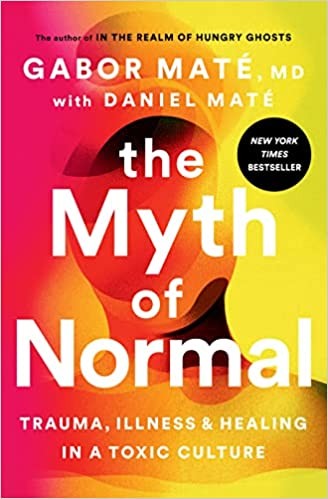
The Myth of Normal is Gabor Maté's most ambitious book, co-written with his son Daniel Maté. Its central claim is that much of what contemporary Western culture treats as normal — chronic stress, emotional disconnection, compulsive striving, physical and mental illness — is not a baseline condition but a symptom of a sick society. The title challenges the idea that the rates of anxiety, depression, addiction, and autoimmune disease we now take for granted represent some natural distribution of human suffering rather than a response to specific cultural and economic conditions.
The book is organized in three parts. The first examines what Maté calls "the landscape of trauma," arguing that trauma is far more pervasive than clinicians typically recognize. He distinguishes between capital-T trauma — acute events like abuse or loss — and lowercase-t trauma: the chronic, cumulative effect of growing up in environments where emotional authenticity is not safe, where a child must suppress their genuine self to maintain attachment. This subtler form he considers more widespread and more damaging in aggregate than the dramatic events that typically receive attention.
The second section traces how this developmental wounding manifests in adult life — in addiction, chronic illness, mental health conditions, and the kinds of personality adaptations (people-pleasing, compulsive achievement, emotional numbness) that society frequently rewards. The third section turns to healing, offering what Maté calls a "compassionate inquiry" framework: not a self-help program but an orientation toward curiosity about one's own inner life, the conditions that shaped it, and the possibility of authentic relationship.
The book is long and at times repetitive — some of the ground covered in earlier Maté works appears again here in broader framing. But as a synthesis of his thinking and as a cultural diagnosis, it is unusually serious. Maté and his son argue that healing individuals without addressing the conditions that produce illness is both inadequate and ultimately political. This makes The Myth of Normal feel more like a manifesto than a medical book, which is both its strength and its limitation.
The big ideas
- 1.
What contemporary Western culture accepts as a normal rate of mental and physical illness is not inevitable — it reflects specific conditions of social disconnection, economic stress, and suppressed emotional development.
- 2.
Trauma is more pervasive than clinical definitions suggest. Chronic experiences of emotional unsafety in childhood — even without abuse or neglect — shape the nervous system in lasting ways.
- 3.
The adaptive strategies people develop to survive difficult childhoods — people-pleasing, emotional suppression, compulsive achievement — often become the source of adult suffering and illness.
