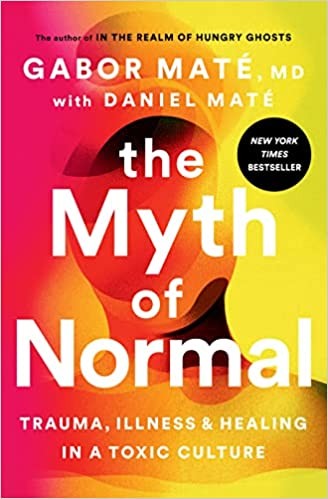
The Myth of Normal by Gabor Maté is a 2022 health book about trauma, mental health, culture and illness. What contemporary Western culture accepts as a normal rate of mental and physical illness is not inevitable — it reflects specific conditions of social disconnection, economic stress, and suppressed emotional development.
Summary
The Myth of Normal is Gabor Maté's most ambitious book, co-written with his son Daniel Maté. Its central claim is that much of what contemporary Western culture treats as normal — chronic stress, emotional disconnection, compulsive striving, physical and mental illness — is not a baseline condition but a symptom of a sick society. The title challenges the idea that the rates of anxiety, depression, addiction, and autoimmune disease we now take for granted represent some natural distribution of human suffering rather than a response to specific cultural and economic conditions.
The book is organized in three parts. The first examines what Maté calls "the landscape of trauma," arguing that trauma is far more pervasive than clinicians typically recognize. He distinguishes between capital-T trauma — acute events like abuse or loss — and lowercase-t trauma: the chronic, cumulative effect of growing up in environments where emotional authenticity is not safe, where a child must suppress their genuine self to maintain attachment. This subtler form he considers more widespread and more damaging in aggregate than the dramatic events that typically receive attention.
The second section traces how this developmental wounding manifests in adult life — in addiction, chronic illness, mental health conditions, and the kinds of personality adaptations (people-pleasing, compulsive achievement, emotional numbness) that society frequently rewards. The third section turns to healing, offering what Maté calls a "compassionate inquiry" framework: not a self-help program but an orientation toward curiosity about one's own inner life, the conditions that shaped it, and the possibility of authentic relationship.
The book is long and at times repetitive — some of the ground covered in earlier Maté works appears again here in broader framing. But as a synthesis of his thinking and as a cultural diagnosis, it is unusually serious. Maté and his son argue that healing individuals without addressing the conditions that produce illness is both inadequate and ultimately political. This makes The Myth of Normal feel more like a manifesto than a medical book, which is both its strength and its limitation.
Talk to The Myth of Normal like its author wrote you back.
Get the ideas that fit your life — not generic summaries.
- Chat with the book
- Audiobook-style main ideas
- Adapts to your life and goals
- Helps you take action
Key takeaways
- 1.
What contemporary Western culture accepts as a normal rate of mental and physical illness is not inevitable — it reflects specific conditions of social disconnection, economic stress, and suppressed emotional development.
- 2.
Trauma is more pervasive than clinical definitions suggest. Chronic experiences of emotional unsafety in childhood — even without abuse or neglect — shape the nervous system in lasting ways.
- 3.
The adaptive strategies people develop to survive difficult childhoods — people-pleasing, emotional suppression, compulsive achievement — often become the source of adult suffering and illness.
- 4.
Authenticity — the capacity to know and express one's genuine emotional state — is not a luxury but a biological need. Its chronic suppression has measurable health consequences.
- 5.
The same cultural values that produce high economic productivity — relentless striving, self-suppression, prioritizing external validation — also produce the rates of chronic illness and mental health crisis we see.
- 6.
Healing is not only individual work. Social conditions that normalize disconnection, overwork, and emotional suppression cannot be addressed through personal therapy alone.
- 7.
Compassionate inquiry, Maté's clinical approach, begins with curiosity rather than judgment about why a person behaves as they do — including behavior that looks like self-destruction from the outside.
- 8.
The separation of mind and body in Western medicine is itself part of the problem. Treating diseases as purely physical events misses the developmental and emotional context in which they arise.
Discussion questions
Use these on your own, with a book club, or as chat starters in Superbook. Book club version, ready to copy or print →
- 1.
Maté argues that contemporary levels of chronic illness and mental health disorder are symptoms of cultural pathology, not natural variation. Do you find that framing clarifying or too sweeping?
- 2.
The book distinguishes between acute trauma and the subtler, cumulative trauma of emotional inauthenticity in childhood. Which of those do you think is less recognized, and why?
- 3.
Maté says the adaptations that helped us survive difficult childhoods often become the source of adult suffering. Can you identify an adaptation in yourself that worked then but costs you now?
- 4.
The book implicates economic and social structures — not just individual histories — in producing illness. What would it mean to take that seriously at a policy level?
- 5.
Maté is broadly skeptical of medical and psychiatric frameworks that treat mental health conditions as brain diseases to be medicated. How do you think about that tension in your own experience or the experience of people you know?
- 6.
The concept of authenticity appears throughout — the idea that genuine emotional expression is a biological need. How easy or difficult is it to be authentic in the environments you spend most of your time in?
- 7.
Maté and his son co-wrote this book. Does knowing that affect how you read the sections on parent-child relationships and intergenerational trauma?
- 8.
The book argues that healing cannot be purely individual. What would collective or cultural healing actually look like in practice?
- 9.
The title suggests that 'normal' in our culture is itself a form of illness. Do you agree? What would genuinely healthy look like as a cultural baseline?
- 10.
Compassionate inquiry involves approaching one's own behavior with curiosity rather than self-criticism. Is that possible for you, and what makes it hard?
- 11.
Maté argues that emotional suppression is rewarded by many institutions — schools, workplaces, social norms. Where have you seen that most clearly?
- 12.
The book covers a lot of ground — addiction, autoimmune disease, mental health, cultural criticism — across 500+ pages. Did the breadth strengthen or weaken the argument for you?
Themes
Frequently asked questions
-
What is The Myth of Normal about?
It argues that the rates of chronic illness, addiction, and mental health crisis in contemporary Western society are not natural but reflect cultural conditions — particularly the suppression of emotional authenticity and the disconnection produced by modern economic life.
-
Is The Myth of Normal worth reading if I've already read Maté's other books?
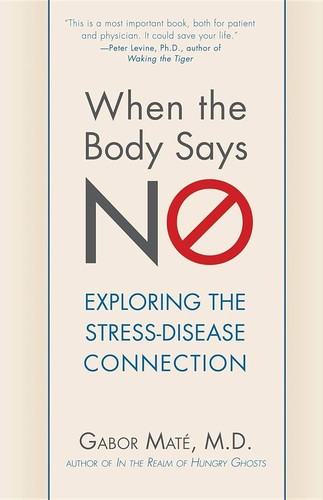
It depends. The book synthesizes and extends his earlier work rather than replacing it. Readers who found When the Body Says No or In the Realm of Hungry Ghosts compelling will find more developed versions of those arguments here, along with a broader cultural critique. Some material will feel familiar.
-
How long is The Myth of Normal?
Around 500 pages — one of Maté's longer books. At average reading pace it takes eight to nine hours. The writing is accessible but the book is dense with case studies and research.
-
Who should read The Myth of Normal?
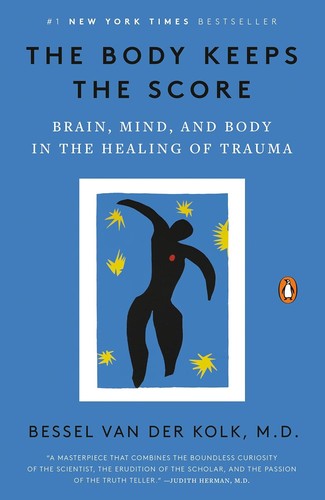
People interested in the social and developmental roots of illness, anyone who found The Body Keeps the Score useful but wants a broader cultural frame, and readers curious about what collective healing might mean beyond individual therapy.
-
Does the book offer practical guidance for healing?
Less than it offers reframing. The compassionate inquiry approach is outlined, but the book is more diagnostic than prescriptive. Readers looking for concrete techniques will find the ideas stimulating but may want to supplement with more applied resources.