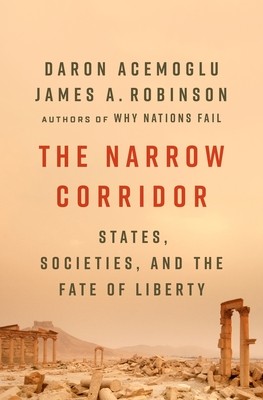
Talk to The Narrow Corridor: States, Societies, and the Fate of Liberty like its author wrote you back.
Get the ideas that fit your life — not generic summaries.
- Chat with the book
- Audiobook-style main ideas
- Adapts to your life and goals
- Helps you take action
What it argues
Daron Acemoglu and James Robinson's follow-up to Why Nations Fail shifts focus from prosperity to liberty. Their central claim is that freedom is not natural or stable — it exists only in a narrow corridor between two failure modes: a state too weak to provide security (the Absent Leviathan) and a state too strong to constrain (the Despotic Leviathan). Only when state power and societal capacity to check that power evolve together does liberty become possible and sustainable.
The "shackled Leviathan" — the authors' label for a state strong enough to function but constrained by an alert citizenry and robust institutions — is the product of a specific historical dynamic they call the Red Queen effect. Like Alice and the Red Queen, the state and society must keep running just to stay in place: each expansion of state power must be matched by new forms of societal organization and resistance, or the corridor narrows and eventually closes. This means liberty is inherently precarious; it is not achieved once and then maintained on autopilot, but requires continuous contestation.
What it gets right
- 1.
Liberty exists only in a narrow corridor between a Despotic Leviathan (state too powerful to check) and an Absent Leviathan (state too weak to provide security or enforce rights).
- 2.
The 'shackled Leviathan' — a state constrained by an engaged society — is not a stable equilibrium. It requires constant maintenance through what the authors call the Red Queen effect.
- 3.
State capacity and societal capacity to check that power must grow together. Building one without the other leads out of the corridor, not through it.
What it covers
Who wrote it
Daron Acemoglu is an economist at MIT who won the Nobel Prize in Economics in 2024 for research on how institutions shape prosperity and development. James A. Robinson is a political scientist and economist at the University of Chicago's Harris School of Public Policy. Together they have spent two decades building an institutional theory of political and economic development, producing Why Nations Fail as well as a substantial body of academic research. The Narrow Corridor represents their most ambitious synthesis, extending the institutional framework to the specific conditions under which liberty can survive.
