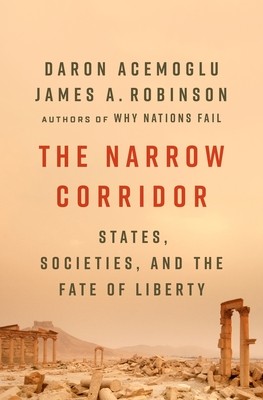
Talk to The Narrow Corridor: States, Societies, and the Fate of Liberty like its author wrote you back.
Get the ideas that fit your life — not generic summaries.
- Chat with the book
- Audiobook-style main ideas
- Adapts to your life and goals
- Helps you take action
The Narrow Corridor: States, Societies, and the Fate of Liberty, in detail
Daron Acemoglu and James Robinson's follow-up to Why Nations Fail shifts focus from prosperity to liberty. Their central claim is that freedom is not natural or stable — it exists only in a narrow corridor between two failure modes: a state too weak to provide security (the Absent Leviathan) and a state too strong to constrain (the Despotic Leviathan). Only when state power and societal capacity to check that power evolve together does liberty become possible and sustainable.
The "shackled Leviathan" — the authors' label for a state strong enough to function but constrained by an alert citizenry and robust institutions — is the product of a specific historical dynamic they call the Red Queen effect. Like Alice and the Red Queen, the state and society must keep running just to stay in place: each expansion of state power must be matched by new forms of societal organization and resistance, or the corridor narrows and eventually closes. This means liberty is inherently precarious; it is not achieved once and then maintained on autopilot, but requires continuous contestation.
The book is structured around a wide range of case studies: ancient Athens, the Tiv of Nigeria, the colonization of the Americas, the European path from feudalism through the Reformation to parliamentary government, and the particular vulnerabilities of contemporary democracies to authoritarian backsliding. The case studies are more anthropologically rich than in Why Nations Fail, drawing on ethnography alongside economics and political science. The result is a more complex story about how societies build and lose the norms, trust, and collective action capacity that power can't simply purchase.
The policy message is uncomfortable: there is no shortcut to liberty, and trying to build it by installing strong states (the development community's preferred approach) or by promoting civil society without state capacity (the NGO approach) both miss the corridor. What matters is whether state and society develop together. For established democracies, the book's warning is that the corridor can narrow from the inside through elite capture, democratic erosion, and the atrophying of civic life. The framework is demanding and the prescriptions are abstract, but as an intellectual account of why liberty is rare and fragile, it is one of the most ambitious attempts of the past decade.
The big ideas
- 1.
Liberty exists only in a narrow corridor between a Despotic Leviathan (state too powerful to check) and an Absent Leviathan (state too weak to provide security or enforce rights).
- 2.
The 'shackled Leviathan' — a state constrained by an engaged society — is not a stable equilibrium. It requires constant maintenance through what the authors call the Red Queen effect.
- 3.
State capacity and societal capacity to check that power must grow together. Building one without the other leads out of the corridor, not through it.
