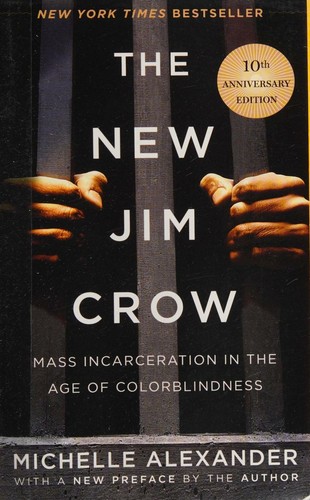
Talk to The New Jim Crow: Mass Incarceration in the Age of Colorblindness like its author wrote you back.
Get the ideas that fit your life — not generic summaries.
- Chat with the book
- Audiobook-style main ideas
- Adapts to your life and goals
- Helps you take action
What it argues
Michelle Alexander's central argument is stark: the United States has not ended racial caste, it has merely redesigned it. Mass incarceration — driven largely by the War on Drugs — functions as a system of racialized social control that strips millions of Black Americans of voting rights, access to housing, employment, and public benefits, all without invoking race explicitly. The genius of the new system, Alexander argues, is its cover of colorblindness. Because the formal rules are race-neutral, the results of the system can be dismissed as the product of individual choices rather than structural design.
Alexander traces the mechanics of the system in detail. The War on Drugs, declared under Nixon and dramatically expanded under Reagan, gave law enforcement extraordinary latitude through civil asset forfeiture, no-knock warrants, and federal funding tied to drug arrest statistics. Police concentrate enforcement in poor, predominantly Black communities not because those communities use drugs at higher rates — the data show similar rates across races — but because it is cheaper and easier to arrest people who lack resources to mount a legal defense. Prosecutorial discretion then converts arrests into convictions through plea bargains, often without trial. The result is a permanent underclass of people formally labeled "felon" who can be denied opportunities for life.
What it gets right
- 1.
Mass incarceration is not simply a crime-control policy gone too far. Alexander argues it is a system of racial control analogous to Jim Crow, using the criminal justice system to strip rights without invoking race.
- 2.
The War on Drugs created the infrastructure for mass incarceration: militarized policing, civil asset forfeiture, mandatory minimums, and federal grants tied to arrest numbers.
- 3.
Drug enforcement is racially skewed not because Black Americans use or sell drugs more, but because enforcement concentrates where legal resistance is weakest — poor communities with overworked public defenders.
What it covers
Who wrote it
Michelle Alexander is a civil rights lawyer, legal scholar, and advocate who has litigated cases before the Supreme Court. She served as director of the Racial Justice Project at the ACLU of Northern California and as an associate professor at Stanford Law School. She later joined The Ohio State University's Moritz College of Law. Her career in civil rights litigation and academic research on race and criminal justice provided the foundation for The New Jim Crow, first published in 2010. The book has sold more than one million copies and is widely assigned in law schools, sociology programs, and political science courses across the United States.
