The New Jim Crow: Mass Incarceration in the Age of Colorblindness by Michelle Alexander is a 2010 politics book about mass incarceration, racial caste, criminal justice. Mass incarceration is not simply a crime-control policy gone too far. Alexander argues it is a system of racial control analogous to Jim Crow, using the criminal justice system to strip rights without invoking race.
Summary
Michelle Alexander's central argument is stark: the United States has not ended racial caste, it has merely redesigned it. Mass incarceration — driven largely by the War on Drugs — functions as a system of racialized social control that strips millions of Black Americans of voting rights, access to housing, employment, and public benefits, all without invoking race explicitly. The genius of the new system, Alexander argues, is its cover of colorblindness. Because the formal rules are race-neutral, the results of the system can be dismissed as the product of individual choices rather than structural design.
Alexander traces the mechanics of the system in detail. The War on Drugs, declared under Nixon and dramatically expanded under Reagan, gave law enforcement extraordinary latitude through civil asset forfeiture, no-knock warrants, and federal funding tied to drug arrest statistics. Police concentrate enforcement in poor, predominantly Black communities not because those communities use drugs at higher rates — the data show similar rates across races — but because it is cheaper and easier to arrest people who lack resources to mount a legal defense. Prosecutorial discretion then converts arrests into convictions through plea bargains, often without trial. The result is a permanent underclass of people formally labeled "felon" who can be denied opportunities for life.
The book's most pointed chapter addresses the collateral consequences of a felony conviction. Once released, formerly incarcerated people can be legally barred from jury duty, public housing, food stamps, student loans, and voting. Alexander argues that these consequences are not incidental — they are the point. They replicate the formal exclusions of Jim Crow while maintaining political plausibility in a civil-rights-era legal framework. The parallel to the post-Reconstruction period, when formal rights were extended to Black Americans but immediately stripped through vagrancy laws and convict leasing, is deliberate and detailed.
Alexander is a lawyer, not a sociologist, and the book reads like a sustained legal and moral argument rather than an empirical study. Readers who want quantitative depth may find the evidentiary base selective. The proposed solution — a broad-based civil rights movement that refuses to abandon people with criminal records — is compelling in principle but underspecified in practice. These limitations aside, The New Jim Crow shifted the terms of American debate about criminal justice. Its argument is hard to refute on its own terms, and a decade and a half after publication it has proven more predictive than alarmist.
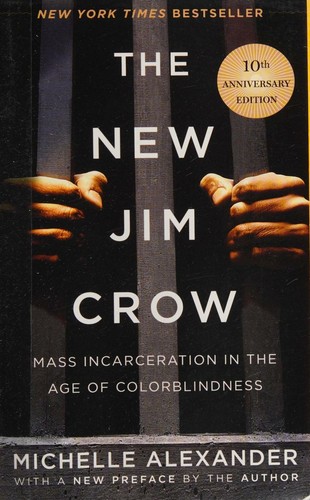
Talk to The New Jim Crow: Mass Incarceration in the Age of Colorblindness like its author wrote you back.
Get the ideas that fit your life — not generic summaries.
- Chat with the book
- Audiobook-style main ideas
- Adapts to your life and goals
- Helps you take action
Key takeaways
- 1.
Mass incarceration is not simply a crime-control policy gone too far. Alexander argues it is a system of racial control analogous to Jim Crow, using the criminal justice system to strip rights without invoking race.
- 2.
The War on Drugs created the infrastructure for mass incarceration: militarized policing, civil asset forfeiture, mandatory minimums, and federal grants tied to arrest numbers.
- 3.
Drug enforcement is racially skewed not because Black Americans use or sell drugs more, but because enforcement concentrates where legal resistance is weakest — poor communities with overworked public defenders.
- 4.
A felony conviction carries legal consequences that extend for life: loss of voting rights, exclusion from public housing, disqualification from student loans, food stamps, and many forms of employment.
- 5.
Colorblindness is the ideology that makes the system durable. When disparate outcomes can be attributed to "neutral" laws and individual choices, collective political challenge becomes harder to organize.
- 6.
The parallel to Jim Crow is not rhetorical. After Reconstruction, vagrancy laws and convict leasing achieved economic and political subordination through formally race-neutral legal mechanisms. Alexander argues the War on Drugs does the same.
- 7.
Prosecutorial discretion functions as a hidden lever. Because most cases resolve through plea bargains, the effective decisions about who is punished and how severely are made before any trial.
- 8.
Alexander calls for a multiracial civil rights movement that explicitly includes people with felony records — arguing that a movement which abandons its most marginalized members cannot win structural change.
Discussion questions
Use these on your own, with a book club, or as chat starters in Superbook. Book club version, ready to copy or print →
- 1.
Alexander argues the racial disparities in drug enforcement are too systematic to be explained by individual bias alone. What would it take to convince a skeptic that a system can be racially discriminatory without racially discriminatory intent?
- 2.
The book draws an explicit parallel between mass incarceration and Jim Crow. Where does that parallel feel most persuasive to you, and where does it feel like it overstates the case?
- 3.
Colorblindness is Alexander's central target — the belief that race-neutral laws produce race-neutral results. Where else in public life does this assumption operate, and what are its consequences there?
- 4.
Alexander contends that the War on Drugs was not primarily about drugs. What evidence from the book supports that claim, and what alternative explanations compete with it?
- 5.
The collateral consequences of felony conviction — loss of housing, voting, benefits — are legal and often invisible to people who haven't experienced them. Did learning about them change how you think about criminal sentences?
- 6.
What role does prosecutorial discretion play in the system Alexander describes? Who holds that discretion accountable, and is that sufficient?
- 7.
Alexander argues that the civil rights community made a strategic error by not fighting the War on Drugs more aggressively in the 1980s and 1990s. What political pressures do you think shaped that choice?
- 8.
The book insists that a genuine reform movement must center people with felony records rather than distance itself from them. What political or social obstacles stand in the way of that kind of coalition?
- 9.
Alexander is trained as a lawyer and writes accordingly. Did you find her argument persuasive, or did you want different kinds of evidence — statistical, ethnographic, comparative — than the book provides?
- 10.
Is it possible to hold both that individuals are responsible for their choices and that systems shape which choices are available and which carry catastrophic penalties? How do you navigate that tension?
- 11.
The book was published in 2010. Given what has happened since — Black Lives Matter, the pandemic, the 2020 uprisings, bipartisan criminal justice reform efforts — which of Alexander's predictions have aged well, and which have not?
- 12.
What would Alexander's proposed solution — a broad civil rights movement inclusive of formerly incarcerated people — require of people who have not been directly touched by the criminal justice system?
Themes
Frequently asked questions
-
What is The New Jim Crow about?
Michelle Alexander argues that mass incarceration in the United States functions as a system of racial caste, comparable to Jim Crow. By criminalizing drug use selectively and imposing lifelong legal disabilities on people with felony convictions, the system strips millions of Black Americans of rights and opportunities while maintaining a veneer of colorblind neutrality.
-
Is The New Jim Crow worth reading?
Yes, if you want to understand the structural arguments against American criminal justice. Alexander writes with legal precision and genuine anger. The book is one-sided in places and the proposed solution is vague, but the core argument about how race-neutral laws produce racially stratified outcomes is carefully constructed and hard to dismiss.
-
How long does it take to read The New Jim Crow?
Roughly six to seven hours at average reading pace for the roughly 300-page argument. The chapters build on each other, so the book rewards reading straight through rather than skipping around.
-
Who should read The New Jim Crow?
Anyone trying to understand the debate over criminal justice reform, mass incarceration, or racial inequality in the United States. It's required reading in many law schools and political science programs and is useful context for policy debates about sentencing reform, drug decriminalization, and felon disenfranchisement.
-
What are the main criticisms of The New Jim Crow?
Critics argue Alexander cherry-picks evidence, overstates the Jim Crow analogy, underweights crime rates and victim preferences in explaining policy, and offers an underspecified solution. Some also note that her framework focuses on Black men to the relative exclusion of Latino and poor white communities also affected by mass incarceration.
Similar books
Between the World and Me
Ta-Nehisi Coates
The Righteous Mind: Why Good People Are Divided by Politics and Religion
Jonathan Haidt
Empire of Pain: The Secret History of the Sackler Dynasty
Patrick Radden Keefe
Killers of the Flower Moon
David Grann
