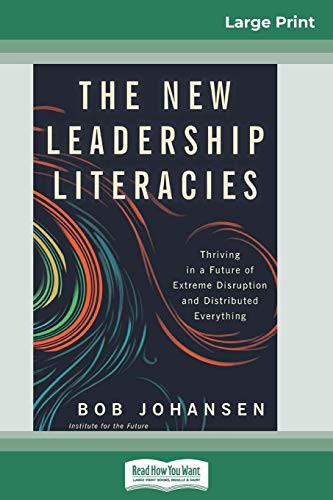
Talk to The New Leadership Literacies like its author wrote you back.
Get the ideas that fit your life — not generic summaries.
- Chat with the book
- Audiobook-style main ideas
- Adapts to your life and goals
- Helps you take action
The New Leadership Literacies, in detail
The New Leadership Literacies is Bob Johansen's forecast of the skills leaders will need for a world that is more volatile, uncertain, complex, and ambiguous than the one most leadership frameworks were designed for. Johansen, a distinguished fellow at the Institute for the Future with decades of experience in technology forecasting, argues that the traditional leadership toolkit — structured planning, hierarchical authority, linear communication — is inadequate for what he projects as the conditions of the next decade. The book introduces five new literacies that he believes leaders must develop to be effective in this environment.
The five literacies are: future-back thinking (working from a long-horizon view of the future toward present decisions, rather than only forward from current reality); voluntary fear engagement (deliberately practicing discomfort to build resilience before it is forced on you); shape-shifting organizational structures (leading organizations that can reconfigure themselves fluidly rather than defending fixed structures); commons creation (building shared resources and mutual benefit rather than competing purely for individual or organizational advantage); and smart machine partnering (developing a productive working relationship with artificial intelligence and automation rather than simply being threatened by it).
Johansen grounds each literacy in forecasts from the Institute for the Future and illustrates them with examples from organizations and leaders navigating early versions of these challenges. The tone is anticipatory rather than urgent — Johansen is a forecaster, not an alarmist, and he is careful to distinguish genuine signals from noise. The book's most useful contribution is probably the vocabulary it provides for trends that many leaders can sense but haven't named clearly.
The book is most valuable for executives and strategists thinking in a five-to-ten-year horizon, and somewhat less useful for managers focused on near-term operational challenges. Some of the forecasts made in 2017 around smart machines read as understated given subsequent AI developments, but the framing around how leaders should relate to those changes — with curiosity and partnership rather than fear — has held up well.
The big ideas
- 1.
Future-back thinking starts from a long-horizon view of where things are going and works backward to present decisions, rather than extrapolating forward from where you are now.
- 2.
Voluntary fear engagement means deliberately practicing with discomfort, uncertainty, and failure in low-stakes contexts so that you build resilience before high-stakes crises arrive.
- 3.
Organizations that can shape-shift — reconfiguring their structures and resources fluidly — will outperform those that defend fixed organizational forms as environments change.
