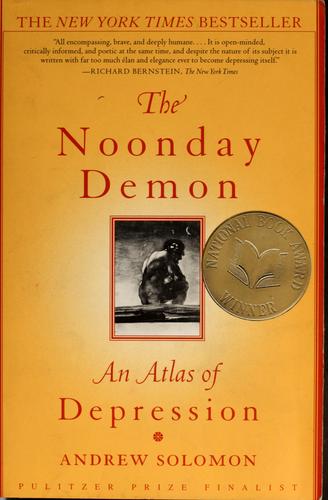
Talk to The Noonday Demon like its author wrote you back.
Get the ideas that fit your life — not generic summaries.
- Chat with the book
- Audiobook-style main ideas
- Adapts to your life and goals
- Helps you take action
The Noonday Demon, in detail
The Noonday Demon is Andrew Solomon's exhaustive, literary account of depression — his own experience of it, its science and treatment history, its cultural and political dimensions, and the lives of people living with it across the world. Published in 2001, it won the National Book Award and remains the most comprehensive single work on depression available to a general reader. At 700 pages, it is not a quick read, but its ambition is matched by its achievement: to describe depression from every possible angle simultaneously.
Solomon begins with his own severe depression, describing the experience with precision rare in mental health literature — the physical weight of it, the way it collapses the future, the animal confusion of a mind unable to recognize itself. He had successful electroconvulsive therapy after multiple medication failures, and his account of ECT is particularly valuable for reducing the stigma attached to a treatment that is both more effective and more commonly feared than it deserves.
The book's subsequent chapters cover the history of depression's treatment, the neuroscience of mood disorders, the pharmaceutical industry's role in shaping treatment, the political economy of mental health care, the relationship between depression and creativity, alternative treatments, poverty and depression, and depression across cultures. Solomon interviews hundreds of people — patients, researchers, clinicians, politicians, and family members of those who died by suicide — and synthesizes an enormous literature with unusual care. His style is aphoristic and precise; individual sentences carry the weight of a careful essayist.
What makes The Noonday Demon unlike other depression books is its refusal to reduce the condition to a single explanation or prescription. Solomon is as interested in the philosophical and existential dimensions of depression — what it means, what it reveals about the limits of the self — as in its neurobiology or treatment algorithms. The result is a book that takes depression seriously as both a medical condition and a human experience, without collapsing either dimension into the other.
The big ideas
- 1.
Depression is not sadness but a different state entirely — an inability to feel, want, or anticipate, often accompanied by physical sensations of weight and paralysis that are as real as any organic disease.
- 2.
No single treatment works for all depressions: Solomon's own response to multiple antidepressant failures and eventual ECT success illustrates how individualized the treatment journey must be.
- 3.
ECT (electroconvulsive therapy) is one of the most effective treatments for severe, treatment-resistant depression, with a better safety record than its popular portrayal implies.
